
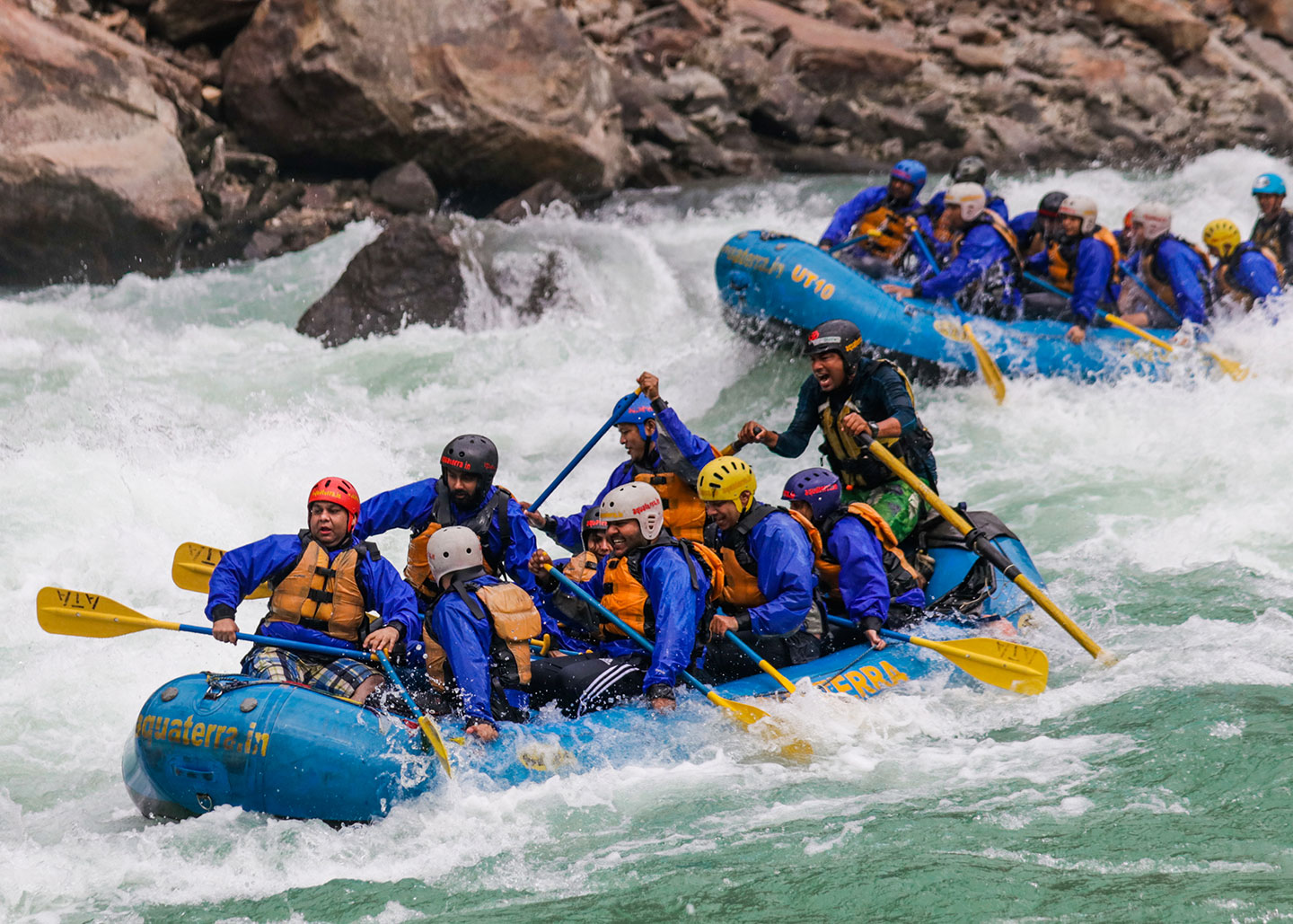
 One of the best water sports, white river rafting, has gained tremendous popularity over the years. The name itself sounds exciting and dangerous to everyone, the strong and extreme current and turbulence in the water make it quite thrilling for adventurers. Therefore, River Rafting, in Rishikesh, is noted to be the ultimate home of adventure sports.
The Himalayan ranges stretch roughly 2,400 km in an unbroken range along the Indian subcontinent’s northern frontier. The snow-fed mountain rivers trace their origin in the Himalayas, descend from their icy high cliffs fed by numerous streams they race along tortuous, boulder-strewn beds cutting deep gorges, and breaking into silvery white rapids, twisting and turning, making India a paradise for water sportsmen.
From Ladakh in the north to Sikkim in the east, these river waters are synonymous with adventure and offer some of the finest white-water rafting in the world.
The holy Ganga and Yamuna rivers, the Indus, and its tributaries, all provide compelling sites for water sports, mainly white river rafting.
Well, Rishikesh is the said hub of river rafting, and there is no doubt about it. It is one of the most favorite destinations for travel explorers as it provides a lot of adventure activities like Rappelling, Bungee Jumping, Flying Fox, Mountain Biking, Giant Swing, Cliff Jumping, Kayaking, and many more. Here you will find River Ganga flowing at its fast pace and surrounded by Garhwal Himalayas; making river rafting here a fun-filled yet exciting adventure. The ranges are separated into four parts, which include Brahmpuri to Rishikesh, which covers about 9 km, Shivpuri to Rishikesh covering about 16 km, Marine Drive to Rishikesh covering about 24 km, and Kaudiyala to Rishikesh that covers about 36 km.
There are numerous River Rafting, in Rishikesh, and camping organizers, in Rishikesh offering various adventure packages. In River rafting, the costs are based on the initiating point of the raft trip i.e Brahmpuri, Shivpuri, etc till Rishikesh. The per-person rates below were quoted when this article was first written; they change every season and vary by operator, so treat them only as a rough guide and confirm current prices before booking.
- Brahmpuri to Rishikesh (about 9 km) – Rs 450/-
- Shivpuri to Rishikesh (about 16 km) – Rs 650/-
- Marine Drive to Rishikesh (about 24 km) – Rs 850/-
- Kaudiyala to Rishikesh (about 36 km) – Rs 1650/-
- Expeditions (per day) – Rs 3150/-
- Camping (1 night 2 days) with 3 meals – Rs 1250/-
The rafting excursions in Rishikesh take place for much of the year but are suspended during the monsoon season, roughly July to mid-September, when the river runs high, but the most favored months are February to May and October to December.
In Uttarakhand, rafting operators must be licensed by the state authorities, and industry bodies such as the Indian Association of Professional Rafting Outfitters (IAPRO) promote safety standards. Reputable expeditions follow established safety standards, rescue procedures and river and camp ethics in line with international practice.
All said and done, though river rafting is indeed scary at times, if given a chance, anyone would love to be a part of another such adventure again.
Understanding the main stretches
Each starting point gives a very different day on the water. The short Brahmpuri stretch is gentle, with small rapids and long calm sections, and suits families, nervous first-timers and anyone who simply wants to float through the valley. The Shivpuri stretch is the most popular choice: around two to three hours on the water, with a series of named rapids such as Roller Coaster and Golf Course, and calm pools where guides sometimes allow strong swimmers into the water with their life jackets on. The Marine Drive stretch adds more distance and more rapids, while the longer Kaudiyala run takes in some of the most challenging water near Rishikesh, including rapids graded around III and IV, and is usually recommended only for fit participants with some experience. Multi-day expeditions further upstream on the Ganga and its tributaries combine rafting with riverside camping.
Who can raft
Most operators set a minimum age, often around 14 for the longer stretches, and some offer shorter trips for younger children. You do not need to be a swimmer for the easier stretches, but you should be comfortable in water, reasonably fit and able to follow instructions. People with heart conditions, back problems, recent surgery or pregnancy should not raft. Always tell your guide about any health issues before you set off.
Safety: what a good trip looks like
The Ganga near Rishikesh is a powerful river, and rafting here is safe only when it is done properly. A good operator will provide a life jacket and helmet that fit you well, a clear safety briefing before you get in the raft, an experienced guide in every boat, and ideally a safety kayaker accompanying the group. You should be taught how to paddle, how to hold on, what to do if you fall out and how to help pull someone back in.
On the water, listen to your guide at all times. Keep your life jacket fastened, never take off your helmet in rapids and do not swim unless the guide says it is safe. Avoid alcohol before or during the trip. Choose licensed operators and check recent reviews rather than picking the cheapest offer on the street.
What to wear and carry
Wear quick-drying clothes, such as synthetic shorts or track pants and a T-shirt, and shoes or sandals with straps that will not come off in the water. Avoid jeans and cotton, which become heavy when wet. Leave valuables in your hotel; if you must carry a phone, use a waterproof pouch, but expect it to get wet. Sunscreen and sunglasses with a strap are useful, since the sun on the water can be fierce. Carry a change of clothes and a towel for the end of the trip.
When to go
The best rafting months are generally late February to May and late September to December, when the water level is high enough for good rapids but not dangerously swollen. Spring brings warmer air and colder snow-melt water, while the post-monsoon months offer strong currents and clear skies. In the coldest winter weeks the water is very cold, so a wetsuit or extra layers may be offered by operators.
Combining rafting with camping
Many visitors combine a rafting trip with a night at a riverside camp upstream of Rishikesh. Camps typically offer tents or cottages, simple meals and evening bonfires where permitted, with the river close by. Choose licensed camps that manage waste responsibly, follow local rules on noise and alcohol, and respect the riverbank, which is fragile and increasingly crowded.
Respecting the river
For millions of people the Ganga is sacred, and Rishikesh is a holy town. Be respectful on the water and at the ghats: do not litter, avoid loud music and remember that the river you are playing on is also a place of prayer. Treat it well and it will give you one of the most memorable adventures in India.
More from Issue 61
- May 2024
- Editor’s Letter: Rishikesh, Where the Ganga Leaves the Hills
- Camping in Rishikesh’s Spiritual Wilderness
- Exploring the Yoga & Meditation Oasis of Rishikesh
- Exploring the Sights of Rishikesh
- A Tapestry of Adventure in Rishikesh
- Haridwar to Shivpuri: The One Road That Explains Rishikesh
- Three Days in Rishikesh, Not a Checklist
- What to Skip on Your First Trip to Rishikesh
- Beyond the Jhulas: Quieter Days at Kunjapuri, Neelkanth and Vashishta Gufa
- Food, Stay and Getting Around in Rishikesh
A quieter Holi in a Braj village
One Walk Between Estates

Sacred Serenity: Manakula Vinayagar Temple, Pondicherry
The Town You Sleep In
Why the base town shapes a monsoon waterfall trip more than any single fall, what to look for, and towns in Karnataka, Kerala and Goa worth considering.
One village ghat upriver
Train versus road that week
Markets before the 20th, not on it
Journeys Worth Discovering
Explore inspiring destinations, memorable journeys and travel stories from across India and beyond.
Explore destinations




