
Garba is one of the most photographed festivals in India. The colours, the movement, the lamps and the sheer number of dancers make it irresistible. But much garba photography falls into two traps: the selfie that reduces the festival to a backdrop, and the intrusive close-up of strangers who never agreed to be photographed. This piece is about a different approach, one that tries to photograph the circle itself, with respect and consent.
Think about what garba is
Before you lift your camera, remember that garba is devotional. The circle moves around a lamp or an image of the goddess. Many participants are fasting, praying and dancing as an act of worship. Treat a garba as you would a religious service: with attention, restraint and respect.
The circle, not the self
The most interesting photographs of garba are usually not of individuals but of the circle as a whole: the rings moving around the lamp, the pattern of bodies and colours, the rhythm made visible. Some approaches to try:
- Wide shots from the edge, showing the full circle and its setting.
- Elevated views, if you are invited onto a balcony or terrace overlooking the circle.
- Slow-shutter images that turn the movement into swirls of colour, with faces blurred.
- Details: feet, hands clapping, dandiya sticks, mirror-work, the lamp itself.
- The musicians, with their permission.
- The quiet moments: elders watching, children asleep on a parent’s lap, the lamp at the end of the night.
Consent
This is the most important point. Do not photograph identifiable individuals without their consent. This applies especially to women and girls, who may be uncomfortable being photographed by strangers and who may face real consequences if their images are shared widely online. Ask first. If someone says no, or seems hesitant, do not take the picture.
If you photograph children, ask their parents or guardians.
If you plan to publish your photographs, whether in a magazine, a website or on social media, you may need explicit permission, and some events have their own rules. Respect them.
Rules at events
Many events have rules about photography, and some ticketed grounds have restrictions on professional cameras, tripods or drones. Temples may prohibit photography in some areas. Check before you go, and follow the rules when you are there. If an organiser asks you to stop, stop.
Drones
Drone use in India is regulated, and crowded events often have specific restrictions. Do not fly a drone over a garba unless you have all required permissions and the organisers’ agreement. A drone over a crowd is a safety risk.
Do not dance and film
If you are in the circle, do not film. Holding up a phone while dancing is dangerous to you and others and disrupts the rhythm. Step out of the circle if you want to take a picture, and step back in when you are done.
Flash
Avoid flash. It is distracting for dancers, can be dazzling in a dark setting and rarely produces good images of moving people. Learn to work with available light, and if you need to, use a fast lens or raise your camera’s sensitivity.
Light
Garba is usually photographed at night, under artificial lights that can range from soft bulbs to bright stage lighting. Some tips:
- Use a wide aperture and higher sensitivity to freeze motion.
- Try slower shutter speeds for creative motion blur.
- Look for the warm light of the lamp at the centre.
- Watch white balance under coloured stage lights.
Position
Find a position at the edge where you will not block anyone’s view or path. Do not stand in entry or exit points. Do not walk across the circle to get a shot. If you are using a tripod, check that it is permitted and that it will not trip anyone.
The musicians
Live musicians are the heart of many garba nights. Ask before photographing them, and be careful not to crowd the stage.
The shrine
The shrine and the aarti are sacred. Ask whether photography is permitted. If it is, keep your distance, avoid flash and do not disrupt the ritual.
Equipment
You do not need professional equipment to photograph garba well. A phone with a good night mode can produce lovely images, particularly of the lamp and the circle from a distance. If you bring a camera, keep it light: a single fast lens is often enough. Carry spare batteries and memory, because cold-weather drain is not an issue but long nights are. Keep your gear in a secure bag, since crowded events are not the place for a large, open camera case. Insurance for your equipment may be worth checking before you travel.
Being patient
Good garba photographs often require patience. Watch the circle for a while before you shoot. Learn its rhythm, notice where the light falls, and wait for the moment when the pattern comes together.
The morning after
Some of the most evocative photographs of Navratri are taken in the morning after: the empty ground, the lamp extinguished, decorations swaying in the breeze, a sweeper clearing up. These quieter images can say as much as the colour of the night.
The selfie question
There is nothing wrong with a photograph of yourself at garba, as a memory. But be quick and considerate. Do not block others to get your shot, do not stand in the circle, and do not frame dancers who have not agreed to be in your picture.
Sharing responsibly
Before you share garba photographs online, think about the people in them. Have they agreed? Would they be comfortable seeing the picture shared widely? Could it cause them harm? When in doubt, choose images where individuals cannot be identified.
Caption with care. Describe the festival accurately, and avoid treating it as merely a costume party or a backdrop.
Giving back
If you take photographs at a society or village garba, consider offering to share them with your hosts. A printed photograph, sent later, can be a much appreciated gift.
The best photograph
The best garba photograph is often the one that makes the viewer feel the circle: the rhythm, the devotion, the sense of community. That photograph is rarely a selfie. It is the result of watching carefully, asking politely and respecting the people who made the moment. Take fewer pictures, take them well, and then put the camera down and join the dance.
More from Issue 77
- Navratri in Gujarat — issue index
- Editor’s letter: Navratri & Garba
- Garba without treating the city as a backdrop
- Ahmedabad nights and a quiet morning after
- Vadodara if Ahmedabad is full
- What to wear, and what not to film
- A first-timer’s nine nights, not all nine
- Food between the circles
- A family courtyard, not only the ticketed ground
- Dates, tickets and temple timings
- One village garba
Colour, consent and where to stand
May 2024
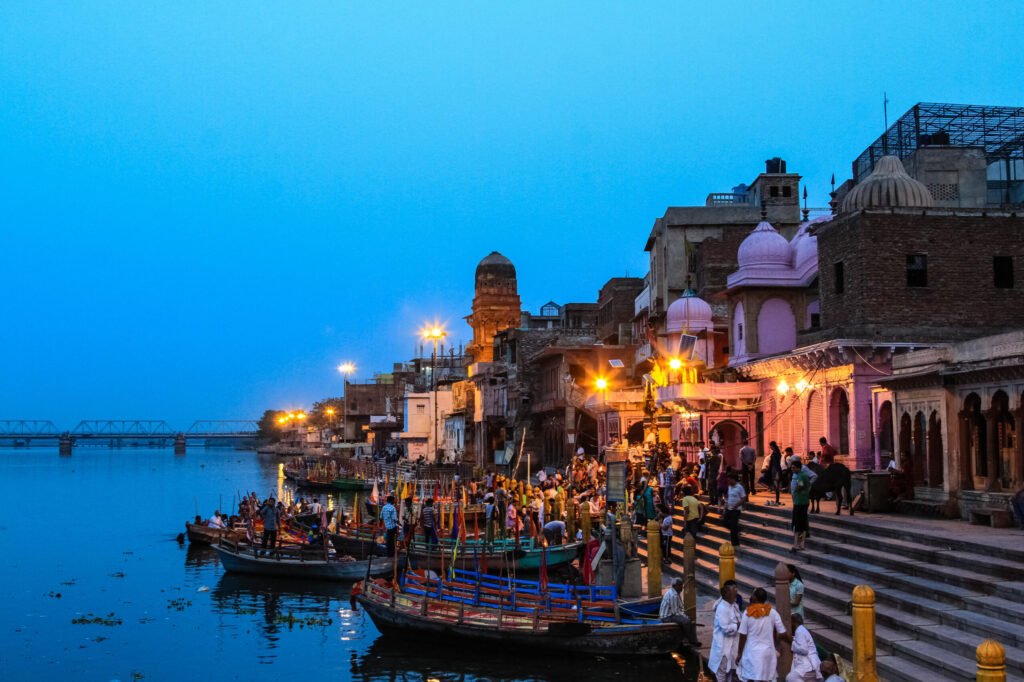
The Yamuna River
The Town You Sleep In
Why the base town shapes a monsoon waterfall trip more than any single fall, what to look for, and towns in Karnataka, Kerala and Goa worth considering.
One village ghat upriver
Train versus road that week
Markets before the 20th, not on it
Journeys Worth Discovering
Explore inspiring destinations, memorable journeys and travel stories from across India and beyond.
Explore destinations




