
In north Kolkata, the great houses turn their backs to the street. To understand them, you have to step into the courtyard.
There is a photograph that every visitor to north Kolkata ends up taking. You step through a heavy wooden door off a noisy lane, through a dark passage, and suddenly the sky opens above you. You are in a square courtyard, ringed with two or three storeys of pillared verandahs and green-shuttered windows. At one end, raised on a plinth, is a deep, arched hall: the thakurdalan, the house’s shrine for the gods. The light falls in a square. The traffic noise drops away. You raise your camera.
This is a photograph of a courtyard, but it is also a photograph of a whole way of life: the joint family, the household deity, the annual festival, the music and theatre, the politics of status in a colonial city. This piece is about how to look at these spaces, where to find them, and how to photograph them with care.
The rajbari and the bonedi bari
From the late eighteenth century, Bengali families who grew rich as agents, bankers, landowners and traders for the East India Company built palatial homes in the north of the city. Locally they are called rajbari (palace) when the family held a title, or bonedi bari (old aristocratic house) more generally. The architecture borrowed freely: Corinthian columns, Venetian shutters, European statues, cast-iron railings, set around the traditional Bengali plan of rooms opening onto a central courtyard.
The anatomy of a courtyard
Learn to read the space and the photograph becomes richer.
- The thakurdalan: the raised, often multi-arched hall at one end of the courtyard, facing north or south, where the family deity lives and where the Durga idol is installed each autumn. Its arches, columns and stucco are often the most ornate part of the house.
- The uthon (courtyard): open to the sky, paved, the stage for festivals, performances and gatherings.
- The verandahs: colonnaded galleries on every floor, from which women of the household traditionally watched events, sometimes behind screens.
- The natmandir: in some houses, a hall for music and dance performances.
Shobhabazar Rajbari
The best known of all is Shobhabazar Rajbari, built by Raja Nabakrishna Deb in the eighteenth century. Its thakurdalan, with its tall cusped arches, faces a broad courtyard where, according to tradition, a celebrated Durga Puja was held in 1757 with Robert Clive among the guests. The puja has been held by the family ever since. Two branches of the family occupy houses across the lane from each other; parts of both are sometimes open to visitors, especially around the festival. Our north Kolkata walk begins here.
Jorasanko Thakur Bari
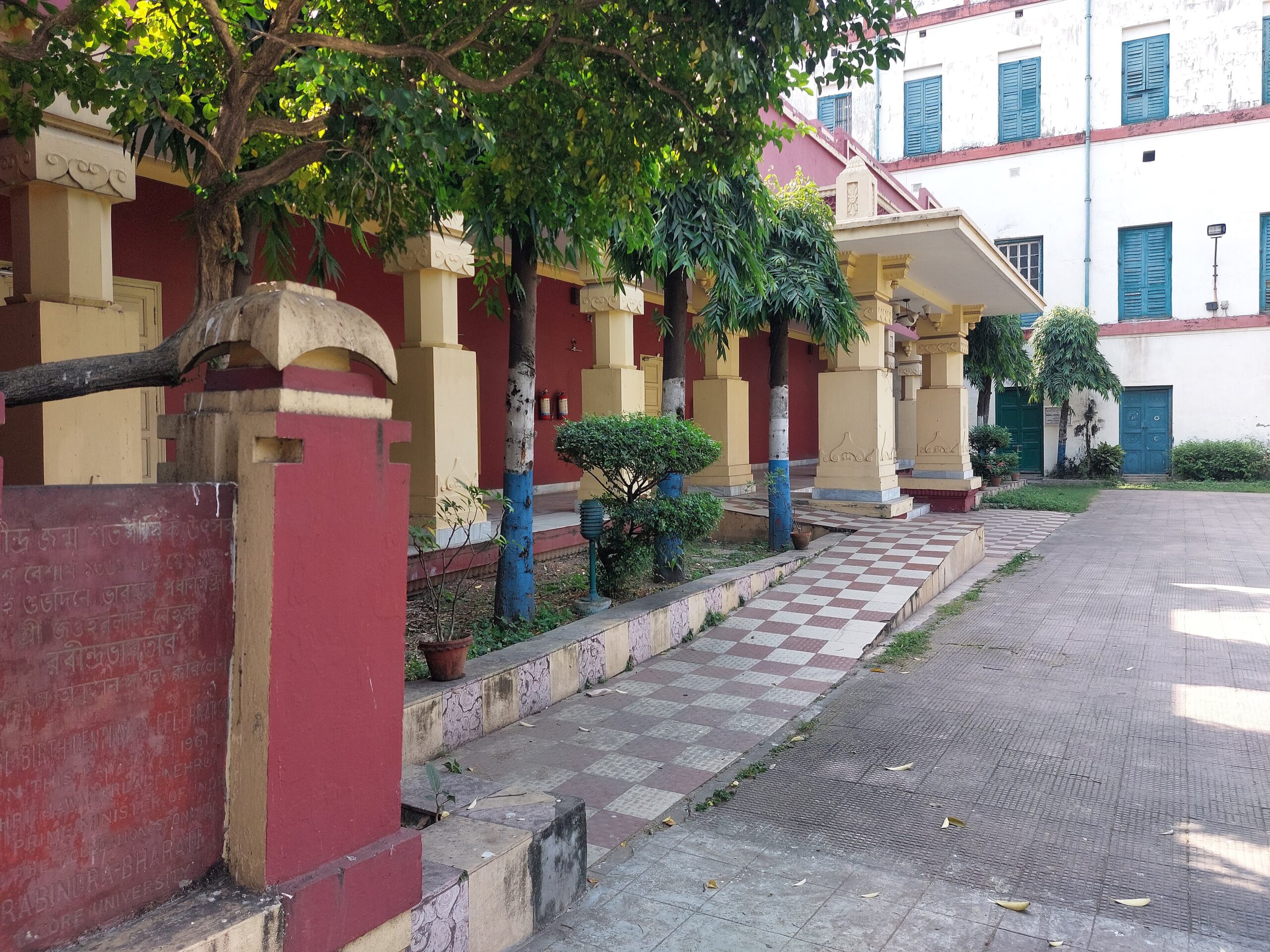
The Tagore family home at Jorasanko, where Rabindranath Tagore was born, is a different kind of courtyard house: red brick, with wide verandahs around a large open square. It is now part of Rabindra Bharati University and houses a museum, so it is the easiest of these great houses to visit. Check opening days before you go.
Beyond the famous three
North Kolkata has many more courtyard houses than the handful that appear in guidebooks. Walk the lanes between Shobhabazar, Bagbazar, Jorabagan and Pathuriaghata and you will pass doorways that open onto the same plan: a passage, a square of sky, a thakurdalan at the far end. Some are beautifully maintained; others are divided among dozens of descendants, with laundry strung across the verandahs and a single bulb lighting the shrine. Heritage walking groups in the city run guided walks through these neighbourhoods and can sometimes arrange introductions to families. It is the most respectful way to see inside.
The Marble Palace
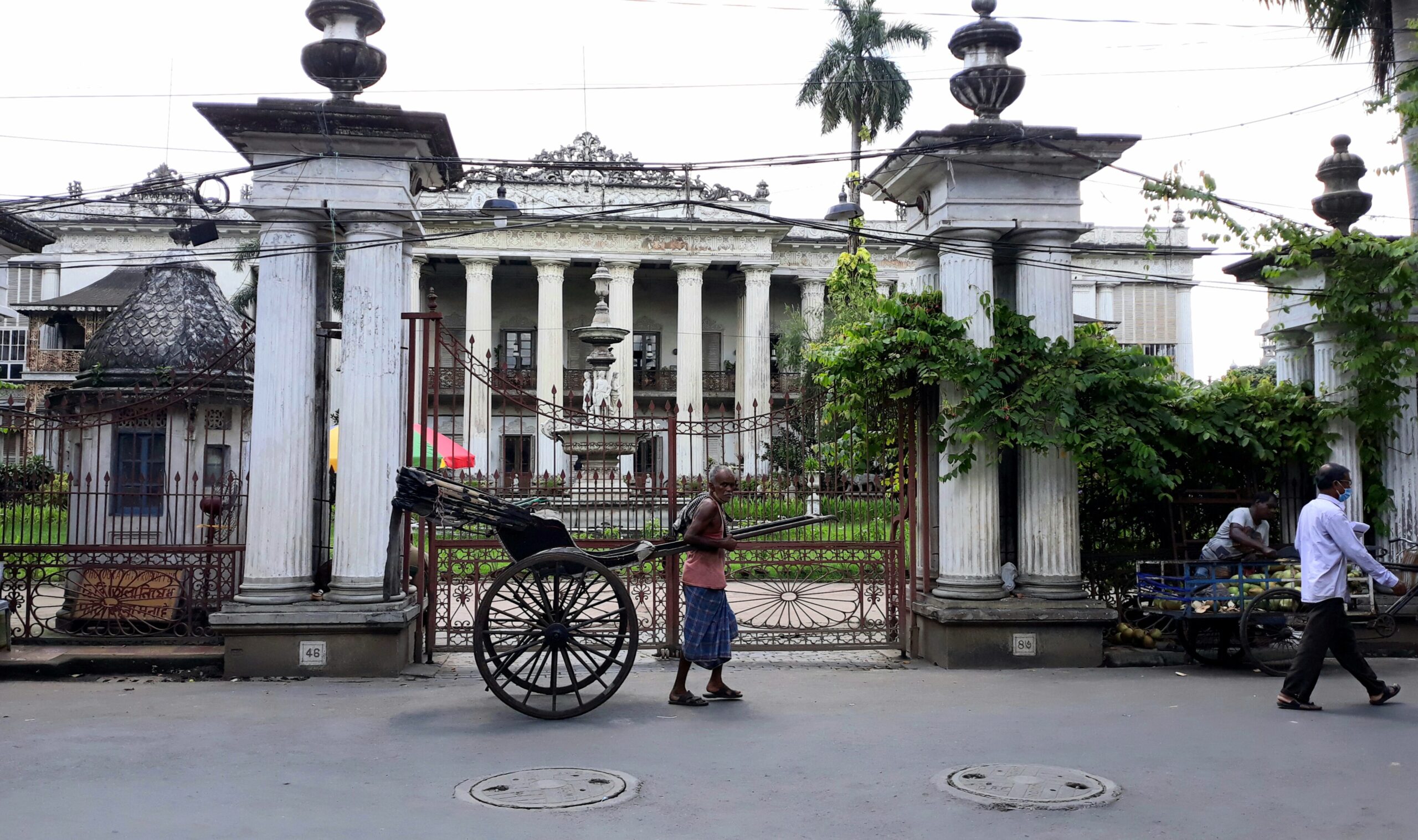
Raja Rajendra Mullick’s 1835 mansion, the Marble Palace, has its own inner courtyard and a family thakurbari. Photography inside is not allowed, and visits need a permit arranged in advance, but you can photograph the extraordinary facade and garden from the grounds.
How to photograph a courtyard
- Ask first. These are family homes and working shrines. Always ask before entering and before photographing. Some families charge a fee or set conditions; respect them.
- Shoot the light. The courtyard is a light well. Mid-morning, when the sun first reaches the floor, or overcast days, give the softest light.
- Go wide, then go close. A wide lens captures the whole square; then look for details: carved doors, cast-iron brackets, worn steps, a brass lamp, a shutter half open.
- Include people with permission. A family member lighting a lamp, a child crossing the courtyard: they give scale and life.
- Do not use flash in shrines.
- Keep shoes off where asked, especially on the thakurdalan.
The best time
In May, courtyards are quiet and empty, giving you clean architectural photographs and time to talk to families. Around Durga Puja, usually in September or October, the thakurdalans come alive with idols, rituals and visitors; many households open their doors, but crowds are heavy. For light, the cool, clear months from November to February are beautiful.
How to reach
Shobhabazar Rajbari is near Shobhabazar Sutanuti Metro station; Jorasanko Thakur Bari and the Marble Palace are near Girish Park and Mahatma Gandhi Road stations on the Blue Line. The lanes are narrow; walk or take a hand-pulled or cycle rickshaw where available.
Where to stay and eat
Central Kolkata has the widest range of hotels. A small number of heritage homestays in north Kolkata let you stay in an old courtyard house; ask about air conditioning in May. For food, look for neighbourhood sweet shops and old cabins nearby; see Kolkata’s food rooms.
Tips
- Many great houses are private; visits depend on the family’s goodwill.
- Dress modestly and speak softly.
- Carry small change for donations at shrines.
- Combine with Kumartuli, where the idols for these courtyards are made.
The photograph, again
Back home, you will look at your photograph of a courtyard: the square of sky, the arches, the light. Remember what it held. A family’s gods. Two centuries of festivals. A city that grew rich, then poorer, and kept its rituals anyway.

Tank Road Denim Market – Denim Of All Sizes, Sizes, And Brands
Delhi to Kasauli on the Old Grand Trunk Road: The One Route That Explains the Weekend Escape

Top 10 Things To Do In Leh Ladakh
The Town You Sleep In
Why the base town shapes a monsoon waterfall trip more than any single fall, what to look for, and towns in Karnataka, Kerala and Goa worth considering.
One village ghat upriver
Train versus road that week
Markets before the 20th, not on it
Journeys Worth Discovering
Explore inspiring destinations, memorable journeys and travel stories from across India and beyond.
Explore destinations




