

Member Type Contributor

Gwalior Fort: A Gem in Madhya Pradesh
September 15, 2022 in Madhya Pradesh, Monuments
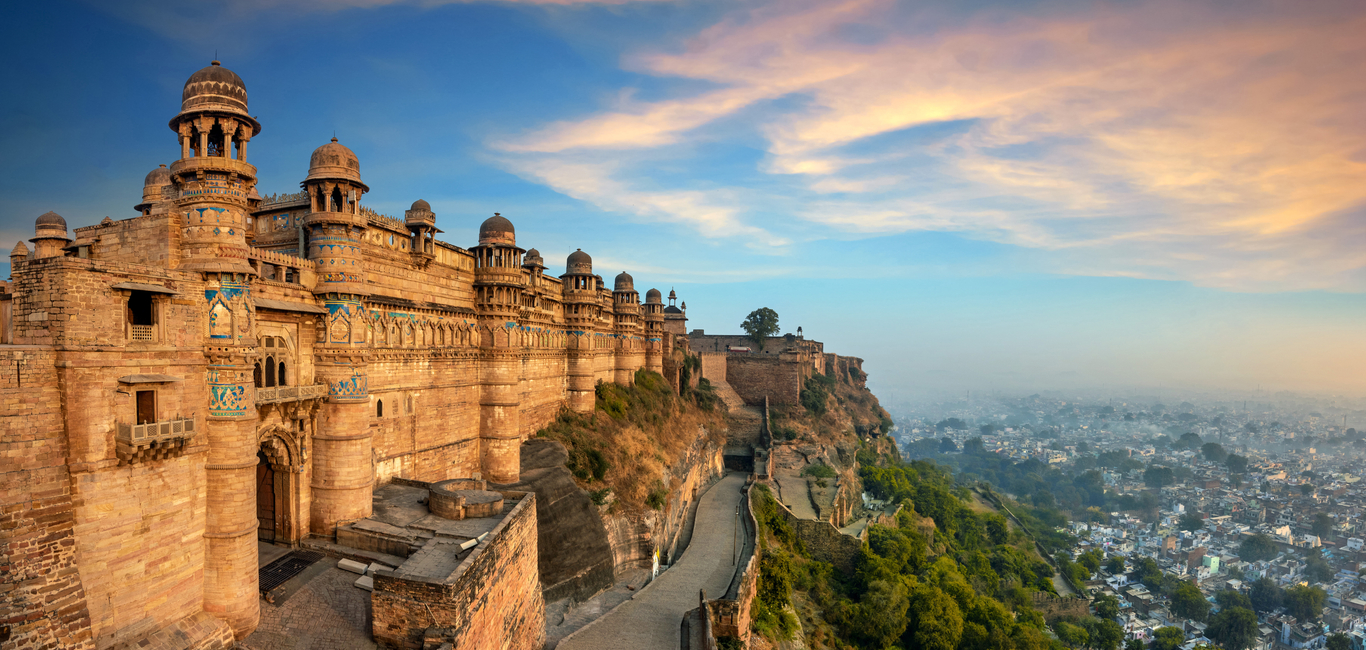
Referred to as ‘the pearl amongst fortresses in India’ by Mughal emperor Babur, the Gwalior Fort is one of the most impenetrable fortresses in northern and southern India and is a place you definitely must visit. Situated on the top of a vast rocky mountain near Gwalior in Madhya Pradesh in central India, this imposing structure dominates the entire city of Gwalior. An inseparable part of the identity and architecture of the town, evidence suggests that it has been around since the 6th Century. It is also where the second oldest reference of the number ‘zero’ has been found in the form of a carving inside a temple on the top of the fort.
The construction of the Gwalior Fort took place in two parts, in two different periods; thus, this architectural marvel has an intriguing history. It has passed from the possession of one dynasty to the other multiple times. The fort complex is well maintained and includes temples, water tanks, and palaces such as Man Mandir, the Gujari, the Jahangir, the Karan, and the Shah Jahan.
History of Gwalior Fort
The period during which the Gwalior Fort was constructed is unknown. According to legends, this imposing fort was built in the 3rd Century by a local king Suraj Sen. The king had recently been cured of leprosy with the help and blessings of a sage named Gwalipa, who had offered him water from a sacred pond. The grateful king then built this fort and named it after the sage. The word Gwalior is derived from the saint’s name- Gwalipa. The sage bestowed the title Pal, which means protector, upon the king; and declared that the fort would remain in his family’s possession as long as they bore this title. Interestingly enough, the fort remained with the 83 descendants of Suraj Sen Pal, but the 84th descendant named Tej Karan lost the fort.
In the years that followed, the Gwalior Fort has witnessed many ups and downs. It also changed hands many times and was held by the Tomars, Mughals, Marathas, and the British, before finally being handed over to the Scindias.
The architecture of Gwalior Fort
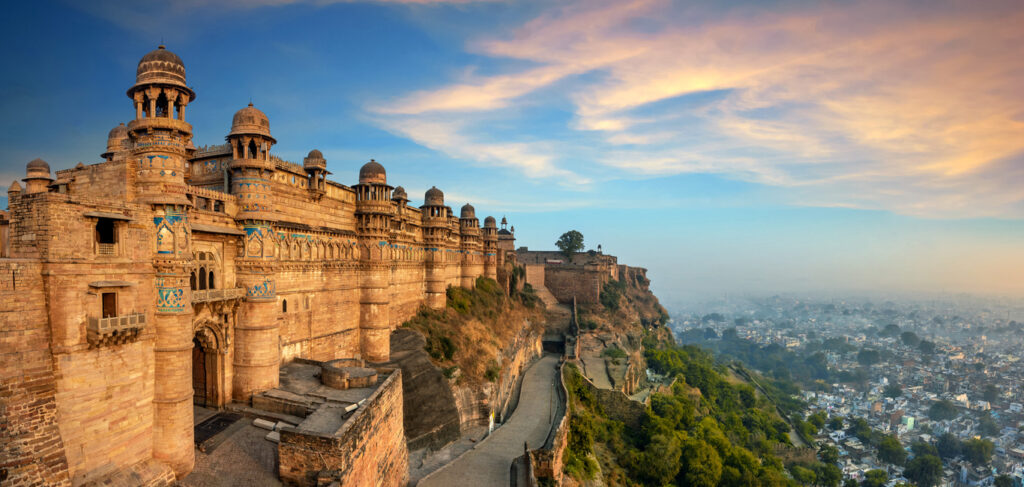
Surrounded by concrete walls of sandstone, the Gwalior Fort encloses three temples, six palaces, and several water tanks and is truly an architectural marvel. The different palaces and temples reflect the architectural finery and skill that existed during those times and continue to be appreciated.
The most beautiful place on the entire premises is undoubtedly the Man Mandir Palace, which with its amazingly elaborate structure, seems to hang at the edge of the impressive fort. Blue ceramic tiles form the facade of this breathtakingly beautiful palace. The Teli-ka-Mandir, built in the 9th-century Dravidian style, rises to a height of over 100 feet and is famous for its blend of South Indian architecture with North Indian decorative motifs, as well as an exquisitely sculpted exterior. The Saas-Bahu temples on the eastern side of the fort are also larger-than-life examples of 11th-century temple architecture.
Gwalior Fort Light & Sound Show
The Gwalior Fort hosts a spectacular sound and light show every evening. This show is exceptionally well executed and makes you feel like you are part of the fort’s rich history and the love story of Raja Man Singh and his queen Mrignayani.
The show takes place in the amphitheater at the Man Mandir. The timings for the show are as follows:
Hindi Show: 7:30 pm
English Show: 8:30 pm
Best Time To Visit Gwalior fort
The best time to visit the Gwalior Fort is during the autumn and spring, that is, between October and March. One can also enjoy the visit during the monsoon when the surrounding is verdant green and fresh and crisp air.
Reputed to be among the most beautiful fortresses in the country, the Gwalior Fort is a thriving tourist destination today. Exuding energy that speaks of the days gone in a harmonious tune, the walls of this fort capture your attention as soon as you step into the complex of Gwalior ka Kila. Much to the pride of the locals, this fort has become a place of worship, wonder, and sheer amazement for travelers from all over the world. Situated around four kilometers from the city center, the fort of Gwalior should be part of your travel itinerary.
While some folks get swept away in the Khajuraho-Ujjain temple-hopping trip, the ones who genuinely love discovering ancient monuments must visit this fortress. The timings of the Gwalior Fort are 9 am to 5 pm every day of the week. The tickets for adults are Rs. 75, Rs. 40 for children and Rs. 250 for foreigners, respectively. The ideal time to visit this magnificent fort would be between October and March, as the temperatures are relatively pleasant.

Let us acquaint you with Gwalior Kila with these 7 interesting facts: –
1. The Ambiguous Origin of the Fort
When we discuss the origins of Gwalior ka Kila, it is essential to note that the main structure has been standing tall since the 6th Century! That’s right. As old as monuments can be, this fort has witnessed every season, war, and love story known in the Indian subcontinent. Legend has it that the Gwalior Fort was built by Suraj Sen, a Sakarwar Rajput, in honor of the saint who saved his life. According to folklore, Gwalipa was a sage who offered the king water from a sacred pond (still found within the Gwalior ka Kila complex) when he suffered from leprosy. Upon consuming this water, the king was cured instantly of the disease and thanked the sage for his kindness. In return, Gwalipa blessed him and his coming generations to rule the land without any hindrances. Experts and historians who provide heritage walk at this fort often tell this fascinating story. History buffs on Gwalior tour packages should participate in one of the walks to learn about the inception of this fort.
2. Monuments and Temples within the Premises
A fort with several temples and monuments inside its premises clarifies how different cultures, traditions, and kingdoms left their mark on it. In its entirety, there are 11 temples belonging to the Jain Tirthankaras, with the tallest idol of Rishabhanatha or Adinatha hoisted up to a height of 58 feet! Besides this, Gwalior Kila’s Teli ka Mandir or Tellika Temple is a famous tourist destination. It was built in the 9th Century by the Gurjara-Pratihara dynasty. Right next to this temple is the Garuda monument in honor of Lord Vishnu. This monument’s most unique characteristic is that it influences Hindu and Islamic architecture.
Even today, the palaces inside the Gwalior Fort have a separate set of admirers. The most popular one was Man Mandir Palace, built by Maharaja Man Singh in the 15th Century. Karn or Karan Mahal, built by his successor, Kirti Singh, is another palace worth visiting. Last but not least is Vikram Mahal, a palace constructed under the rule of Vikramaditya Singh, the eldest son of the first Tomar king.
3. Invasion by Foreign Powers
In 1505, Sikander Lodi attempted to invade the Gwalior Fort. However, the attempt was unsuccessful. This is because the Tomars were renowned for their valor and left no stone unturned to protect their fortress. After the demise of Man Singh, the battle ended with Gwalior Kila in the hands of the Delhi Sultanate. But with the rising presence of the Mughals in North India, this fort was snatched away within a decade. A power struggle began in 1542 between the Delhi Sultanate and the Mughals, with Gwalior Kila as the winning prize. Sher Shah Suri took the entire fortress in a fierce battle. Upon your visit here today, you will understand why this fort was significant to these powers. Not only is it strategically located on a hilltop, but it also brings out the grandeur of an empire ruling in it. Keeping this in mind, you will also learn that Akbar was the first Mughal emperor to turn this glorious fort into a prison. Information on the Gwalior Fort’s captures by various kingdoms can also be found at the Archaeological Museum within the premises.
4. Prison for the Sixth Sikh Guru
As mentioned earlier, the most benevolent Mughal emperor, Akbar, first used the Gwalior Fort as a prison for political entities that infiltrated his empire. Following his father’s footsteps, Jahangir made sure that this fortress was utilized in oppressing the sixth guru of Sikhism, Guru Hargobind. To shed some light on the youngest religion in India, spreading harmony under the rule of the Mughals, you should know that Guru Arjan was executed by Jahangir because of their increasing influence on the people. Guru Hargobind, a born warrior, dedicated his life against the Mughal rule and was imprisoned at Gwalior Kila for 14 years. Mind you, he was only 11 years old at that time. The reason given by the Mughal authorities was that the Sikhs could not pay the fines imposed on them. Although there is no known record of the time of his release, it is estimated to be around 1611. The fort of Gwalior became a sight of oppression for the Sikhs, but the positive outcome was the introduction of Bandi Chhor Divas at Gurdwara Data Bandi Chhor situated inside the complex. This festival is still celebrated in honor of Guru Hargobind’s release from the Mughals. Because of this historical event, this fort is part of the Gwalior sightseeing one-day tour for people from the Sikh community.
5. Home to the Second Oldest “Zero.”
Did you know that Gwalior Fort has the ‘second oldest zero recorded history? On your way to Hathi Pol or Elephant Gate, you will come across Chaturbuj temple dedicated to Lord Vishnu. This particular temple is one of the places to visit in Gwalior to read the inscription depicting zero in a mathematical equation. This plaque dates back to 875 CE, second to the oldest note with zero in the world! To elaborate on the written details, the inscription mentions a land grant of 270 hastas (measuring unit in ancient times) made for a flower garden.
Along with this, it mentions a daily grant for 50 flower garlands as well. The numbers “270” and “50” both have zero mentioned in them. The timing in the Gwalior Fort best suited for observing the “zero” is right when the gates open, as it is less crowded.
6. A Temple Construction Out of a Domestic Feud
As far as domestic feuds are concerned in India, we all know that nothing good comes from it. Except for this particular historical fact. Sahastrabahu Temple, commonly known as Sas-Bahu Temple, located inside the Gwalior Fort, is perhaps the only positive outcome of an altercation between a mother-in-law and a daughter-in-law. During the reign of the Kachchhapaghatas, it is believed that a feud broke out between the mother-in-law and her daughter-in-law regarding the deity to be worshipped inside this temple. To resolve this issue, both Lord Shiva’s and Lord Vishnu’s gods were accommodated inside this twin temple to please both the ladies of the royal family. Imagine if domestic matters could be resolved so peacefully in today’s times!
7. The Legend of Tansen’s Tamarind Tree
Tansen, the legendary musician of the Mughal courts, has a melodious connection with Gwalior Kila. A tamarind tree inside the fort is believed to have leaves that can make your voice harmonious! This folklore has been around for ages mainly because of Tansen’s tomb inside the fort and his magical voice reverberating into nearby villages. The sound and light show organized nowadays illustrates this legend along with the love story of Man Singh and Mrignayani in the most peaceful manner. The timings of this show differ according to the season, so you can plan your trip to this fort accordingly.
It is with good reason that Gwalior Fort stakes its claim as one of the top hill forts of India. Visit it and experience it in its full glory!
Visit MakeMyTrip for bookings. Also, have a look at our various monthly issues.
The Magnificent Golconda Fort in Telangana
September 15, 2022 in Monuments, Telangana
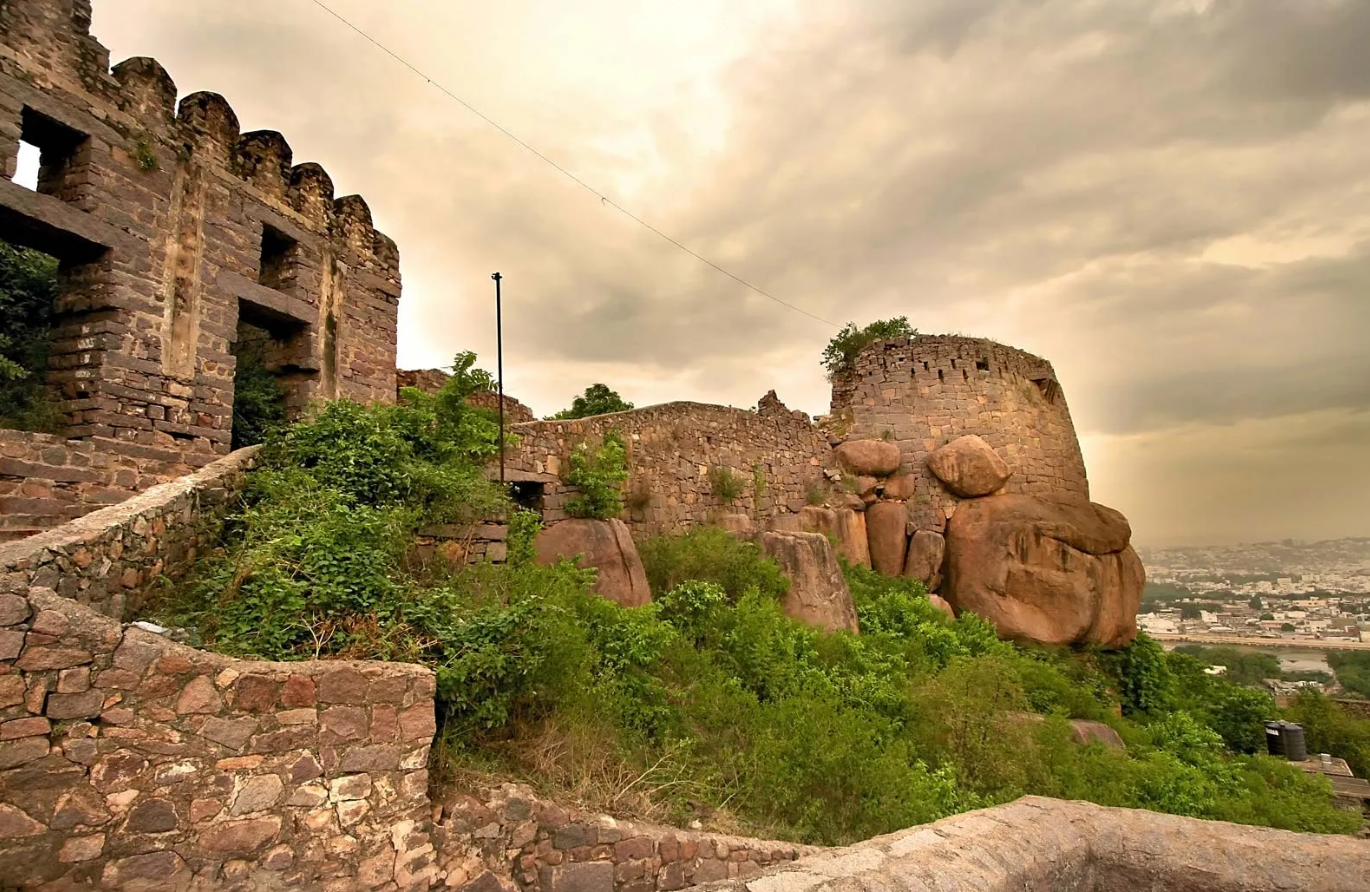
Situated in the Western part of the beautiful city of Hyderabad, approximately 9 km from Hussain Sagar Lake, Golconda Fort is one of the region’s best-preserved monuments. The construction of this Fort was completed in the 1600s, and it is reputed for being where the mighty Koh-I-Noor diamond was once stored. It is said that if you clap your hands at the bottom of the Fort, the echoes of it can be heard right to the top! The architecture, the legends, the history, and the mystery of Golconda Fort add to its allure and make it one of the must-visit places in Hyderabad.
The mines here produce some of the most coveted and popular gems ever known in the world, such as Idol’s Eye, the Hope Diamond, Darya-i-noor, and the famous Koo-i-noor.
In the evening, Golconda Fort comes to life with the light and sound show which showcases snippets from its regal past. The grandeur, the rise, and the fall of the Fort are all spectacular in their own right. With its fascinating history, the place is worth a visit.

Golconda Fort Sound & Light Show
Golconda Fort is one of the most famous landmarks in the city of Hyderabad. Its ancient remains differentiate it from the rest of tourist attractions and enhance its beauty. It is organized in the ruins of the Rani Mahal section of the Fort.
Some details about the show:
1st show in English (on all days)
2nd show in Telugu (on Monday, Wednesday, and Friday), in Hindi (on Tuesday, Thursday, Saturday, and Sunday)
Timings of the show-
First show- November to February- 6:30 pm
March to October- 7 pm
Second show November to February- 7:45 pm
March to October- 8:15 pm
Timings of the ticket counter- Open from 5:30 pm
Cost of tickets-
The ticket costs INR 140 (adult) and INR 110 (child) for the executive class
For standard class, INR 80 (adult) and INR 60 (child).
The light and sound show should be experienced whenever you plan a visit to the Golkonda Fort.
History of Golconda Fort
Founded in the approximately 12th Century by the Kakatiya Kings, this massive Golconda Fort with eight gates and 87 bastions was later built by Qutub Shahi Kings.
The name Golconda Fort has a legend behind it. As per the story, a shepherd boy once walked on this hill when he came across a God idol. The news about the shepherd boy and his findings reached the then ruler of the Kakatiya Dynasty. The King built a fort on the hill known as Golconda (Shepherd’s Hill) Fort.
However, almost 200 years later, the Fort came under Bahamani rulers. Later, Qutub Shahi Kings took the Fort under their control and extended it further. The Fort was fortified and expanded during the reign of Bahamani rulers and the Qutub Shahi Dynasty. Later in 1687, this Fort came under the rule of Mughal emperor Aurangzeb. It was then the Fort was left unattended.
At present, the Golconda Fort constitutes a complex layout of palaces, mosques, and pavilions, which unfortunately are in ruins.
It is said that Golconda used to be a famous diamond market attracting merchants from all over the world. At Golconda, the famous Kohinoor and Hope diamonds, along with others such as The Regent Diamond, Darya-e Nur, and Nur-Ul-Ain Diamond, were stored.

The Architecture of Golconda Fort
With perimeters of around 11 kilometers, the Fort has 15 to 18-foot high walls. It has enormous gates that have pointed iron spikes on them. This protected the Fort from Elephants damaging the Fort as well as enemy attacks. Golconda fort presents mesmerizing architecture that will astonish you at every step. This Fort was built on a granite rock with a height of 12 meters. A massive rampart around the Golconda fort was built, a glimpse of which can still be seen.
The system of acoustics in the Fort is something that attracts every visitor. The sound of clapping at the entrance can be heard at the ‘Bala Hissar’, the highest point almost a kilometer away. This system was used for communication purposes, especially to alert the royal in case of any attack.
Other attractive features of the Fort include the water supply system, which does leave many marveling at the advancement of the technical and scientific knowledge while constructing this Fort. Another popular aspect is the ‘Rahban’ cannon.
Ramdas’ prison is one of the popular spots inside the Fort. According to legend, Ramdas, a revenue collector in Abdul Hasan Shah’s court, was imprisoned. During his imprisonment, he carved Hindu deities on the wall of his cell. One can see many carvings of Hindu Lord Hanuman on the wall, now smeared with holy vermillion. A sacred lamp or two (diyas) is also lit in front of the carvings.
The main entrance of the Fort is named Fateh Darwaza, which means Victory Gate in English. It was called after Aurangzeb’s army had entered the Fort through this gate. Not just for the victory procession of his army, this gate also attracts visitors with its marvelous acoustics.
Showcasing architectural excellence, this gate has been built so that if one claps at a certain point of the entrance, the sound of clapping can be heard at the topmost pavilion. Another attractive feature of Golconda Fort is the 80 feet tree which is said to be more than 800 years old.
The Fort also consists of many mounted cannons and drawbridges. Huge halls, mosques, eight gateways, and stables add to the immense enormity of its magnificent architecture. There is speculation that an underground tunnel starts from Durbar hall and ends at the foot of the hill. It is believed to be a secret passage to escape in case of any attack. However, no such course has been found to date.
Best Time To Visit Golconda Fort
The best time to visit the city of Hyderabad is during the months extending from September to March as the climate is moderate at that time and quite enjoyable. Golconda Fort can be visited during the evening hours when the weather is pleasant, and some sound and light shows can be enjoyed.
Golconda Fort Hyderabad is an outstanding example of brilliant engineering and magical architecture. Located 11km from the city, it is the most famous Hyderabad tourist place. The name of the Fort has been derived from the Telugu words “Golla” and “Konda”, which together mean ‘Shepherd’s Hill’.
However, keep the Golconda Fort timings and entry fee in mind before planning a visit to this regal symbol of history. For instance, Golconda fort timings are from 9 am to 5.30 pm. After that, visitors are not allowed to enter the Fort unless they go for the light and show at night. Hence, to explore the beauty of this place at leisure, plan your visit early in the day.
An impressive structure, which once would have bewitched every onlooker, stands majestically even today. Golconda Fort will impress you with the highly advanced techniques used back then, its sturdy structure, and an outstanding view of the surrounding city.
The sunset from the top of the Fort is awe-inspiring. One of Hyderabad’s most popular and supreme monuments, Golconda Fort, allures every visitor with its unparalleled beauty and grandeur. A Hyderabad Tour is incomplete without a visit to this Fort.
Visit MakeMyTrip for bookings. Also, have a look at our various monthly issues.
The Kangra Fort: The Oldest Dated Fort In Indian History
September 15, 2022 in Himachal Pradesh, Monuments
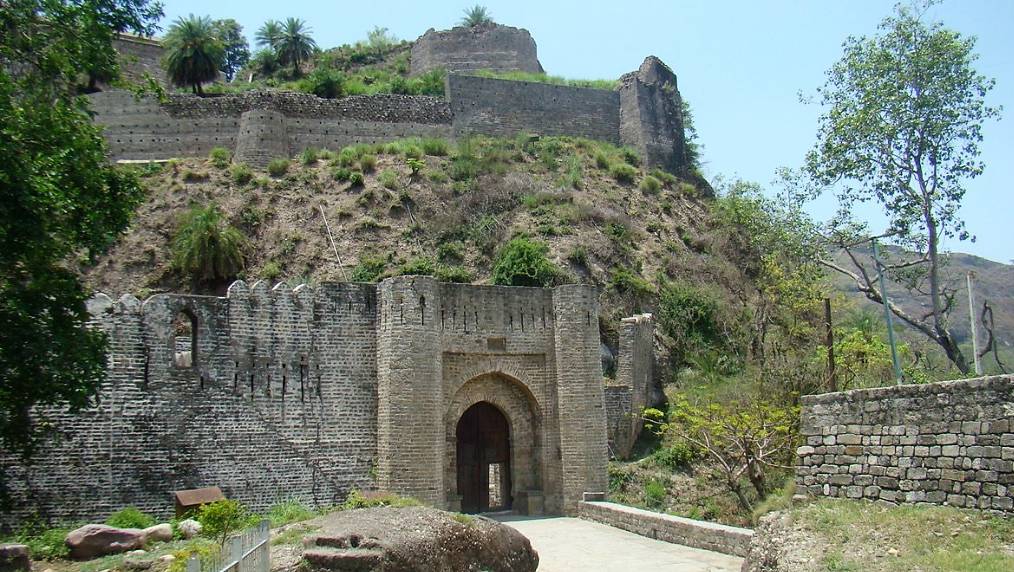
Situated on the outskirts of the town of Kangra, in the state of Himachal Pradesh, the Kangra Fort is witness to thousands of years of grandeur, invasion, war, wealth, and evolution. This mighty Fort traces its origins to the ancient Trigarta Kingdom, which is mentioned in the Mahabharata epic. It is the largest Fort in the Himalayas and probably the oldest dated Fort in India. Occupying the lower valley of the Beas and its tributaries, it was one of the leading hill stations of Punjab and Himachal earlier.
“You must pass through the gate leg first. Never lead with your head because if there is an enemy on the other side, you might lose your head”. This tip by Tikaraj Aishwarya Katoch (present scion of the Katoch dynasty) indicates the heavy security in the Fort maintained by the kings to protect the unimaginable treasures inside. Though the tales of these treasures are nothing but stories in this ruined Fort now, there was a time when the sanctum sanctorum of the Kangra Fort held unimaginable riches, which were offered to the large idol in the Brijeshwari temple inside the Fort. Perhaps because of these treasures, this colossal Fort has been attacked many times. Almost every ruler has tried to lay control over the Kangra fort, be it an invader or a native ruler.
After Jahangir mercilessly captured the fort in1622, it was Raja Sansar Chand-II who finally succeeded in recovering the ancient Fort of his ancestors from the Mughals in 1789. Ultimately it was handed over to the British and was occupied by them until it was heavily damaged by the earthquake of April 4April 4, 1905. Although it is entirely in ruins now, it was a structure of architectural marvel once. The Kangra fort in itself is a symbol of elegance and royalty.

The Architecture Of Kangra Fort
The entrance of the Kangra fort is through a small courtyard enclosed by two gates known as “Phatak” and are only dated from after the Sikh period, as it appears from an inscription at the entrance. From here onwards, a long and narrow passage leads to the top of the magnificent Fort through the Ahani and Amiri Darwaza, both attributed to Nawab Alif Khan, the first governor of Kangra appointed under the Great Moghuls. After approximately 500 feet from the outer gate, the passage takes a turn at a very sharp angle and passes through the Jahangiri Darwaza, which has the appearance of a Muhammadan building entirely and, judging from its name, would seem to have been raised by Jahangir after his conquest of the Fort in A.D. 1620. A white marble slab bearing a Persian inscription, recovered in two fragments in 1905, originally occupied a recessed panel over the gate. It is, in all probability, a record of Jahangir’s conquest of the Fort.
Though the Fort is mostly in ruins, the royal structure that once stood there can be readily envisaged. In addition to the architectural feat of Kangra fort, it also offers a mesmerizing view from its roof.
History of Kangra Fort
It is said that the Kangra fort was built by Maharaja Susharma Chandra in the Katoch dynasty around 3500 years ago. The Maharaja Shushant Sharma fought alongside the Kauravas in the Battle of Kurukshetra, mentioned in the Mahabharata. After being defeated, he took Trigarta under his control and built the Kangra fort. The Kangra fort housed the temple of Brijeshwari. Therefore it received many valuable gifts and donations from its devotees. It can be easily guessed that this Fort held unimaginable treasures and thus became a common target for other rulers and foreign invaders. The first ruler to attack the Fort was Raja of Kashmir Sreshthha in 470 AD. The first alien invasion of the Fort was by Mahmud of Ghazni in 1009 AD. Following his footsteps came the Turkish Sultan Muhammad Bin Tughluq, and his successor Firoz Shah Tughluq took over after his death.
These foreign invaders attacked the Fort only in the quest for treasures. It is said that Mahmud killed everyone inside the Fort during his invasion and looted wells of wealth out of 21. After 52 failed attempts to recover Kangra Forts from the Turks by Akbar in 1615, it was finally his son Jahangir who captured the Fort in 1620.
In 1758, Ghamand Chand, a successor of the Katochs, was appointed the governor of Jalandhar by Ahmed Shah Abdali. His grandson Sansar Chand strengthened his forces and finally defeated the ruler Saif Ali Khan and recovered the throne of his ancestors in 1789. Sansar Chand proved himself to be a powerful ruler and annexed many kingdoms of the neighboring regions. The defeated kings then asked for help from the Gurkha commander Amar Singh Thapa. The Gurkha troops invaded the Fort and captured it. The defeat forced Maharaja Sansar Chand into an alliance with Maharaja Ranjit Singh. The alliance cost him the Sandhata district and the Kangra fort. The rulers of Kangra could never gain control over the Fort again. They were transferred to the Lahore Darbar. Eventually, the British took control over the Fort after the Sikh war.
The history of Kangra Fort is smeared with wars, blood, deceit, and loots. But the walls of this ancient Fort stood solid and tall until it succumbed to an earthquake on April 4April 4, 1905.
Visit MakeMyTrip for bookings. Also, have a look at our various monthly issues.

Jaigarh Fort: A Majestic Affair in India’s Pink City, Jaipur
September 15, 2022 in Monuments, Rajasthan
Jaigarh Fort is a monumental fort located on the Aravalli Ranges of Rajasthan, towering at an impressive height of 500m above sea level. The fort was constructed in 1726 by the famous Raja Jai Singh II to fortify the Amer Fort.
You can see an unobstructed view of Amer Fort and its complex from the Jaigarh Fort and a breathtaking view of the green hills and lakes surrounding the fort. It is one of the most distinctive historical monuments in the Jaipur area and has many unique features that make it special.
The largest canyon in the world, the Jaivana Cannon, can be found inside the premises. The canon was built inside the Jaigarh Fort and is said to have participated in many famous Rajput battles and wars. Other attractions inside the fort include the Vilas Mandir, the Aram Mandir, Laxmi Vilas, and the Lalit Mandir.
A unique feature of the fort is the lattice-work windows from which you can observe the expanse of the surrounding landscape and the sizeable Persian garden, which has four distinct parts. The original purpose of the Jaigarh Fort was to store arms, ammunition, armor, and supplies for the Amer Fort in case of war.
It is now a significant historical monument, with visitors traveling from far and wide to get an insight into the rich culture and history of the Rajputs of Amer. The memorial is approximately 3 kilometers long and has a width of 1.

History of Jaigarh Fort:
The area that is home to the Jaigarh Fort and the Amer Fort was initially ruled by the Meenas, and it is believed that the Jaigarh Fort was built by them along with the Amer Fort. The Meenas originally built the fort as the home of the King and the royal family, who resided there, apart from their residency in the Amer Fort.
After the Meenas were overthrown by the Kachwahas, they made specific changes to the fort’s structure. During the rule of the Mughal ruler Aurangzeb, the defense came under the charge of Raja Jai Singh II, who made significant changes to the design and utility of the fort, and because of his contributions, the fort came to be named Jaigarh- after Jai Singh.
Throughout the reign of the Mughals, including that of the great emperor Akbar, Jaigarh Fort was used as a place to keep the treasure, loot, arms, ammunition, and other supplies for the Rajputs. An exciting feature about the fort is that despite seeing several rules and coming under siege many times, no one truly ever managed to capture the fort, which is why it earned the name- Victory Fort.
The Architecture of Jaigarh Fort:
Jaigarh Fort is a massive sandstone structure built in Indo-Persian style, complete with cyclopean walls that have been held together with lime mortar. The system consists of a square garden surrounded by ramparts leading to the upper levels of the fort.
There is also a central watchtower from where one can get a clear, unobstructed view of the stunning landscape on all sides. One of the most exciting features of the fort’s architecture is the lattice windows, which are so intricately designed that one can get a clear view of the outdoors from inside, but no one from outside can see the interiors through these windows.
The main entrance of the Jaigarh Fort is called the Dungar Darwaza. There are two ancient temples within the premises of the fort, including the Ram Harihar Temple, built in the 10th century, and the Kal Bhairav Temple, which has existed since the 12th century.
Guests can walk through courtrooms, restrooms, assembly halls, and much more, which are a testimony to the brilliant architecture and construction techniques of the Rajputs. Fortified gates throughout the fort offer incredible views of the Aravalli ranges and Sagar Lake located in the vicinity of the fort.

Attractions around Jaigarh Fort:
Even though Jaigarh Fort is an exciting tourist attraction in itself, there are several exciting places to visit in the vicinity. Here are interesting attractions around Jaigarh Fort:
- Amber Fort – Jaigarh Fort was built as a fortification for the famous Amber Fort. Amber Fort has a rich and varied history, with opulent structures, great views, and royal architecture that will leave you spellbound. The fort took 148 years to build, and every corner of the system will remind you of the grandeur of the Rajputs.
- The Shila Devi Temple – The Shila Devi Temple is a temple dedicated to Goddess Kali, located inside the Amber Fort. The temple is made of sandstone and is surrounded by a geometric garden. The temple, over 400 years old, is said to have been constructed for a Bengali princess who came to live in Amber Fort after her wedding to a Rajput Prince.
- Anokhi Museum of Hand Printing – The Anokhi Museum is a small, quaint shop that is dedicated to the age-old craft of block printing by hand. It is a short walk of around 18 minutes from the Jaigarh Fort. You can buy authentic local textiles, handicrafts, and much more when you are here. It is also home to a small café that serves some of the best organic coffee in the area.
- Panna Meena ka Kund – This ancient well is located a short distance from the fort. This incredible structure, built in the 16th century, was used as a well and irrigation center by the locals of the area, who used to gather and discuss their daily lives. There is also an adjoining temple, another interesting heritage site worth visiting.
- Elephantastic – Jaipur and its surrounding areas are known for their exciting elephant rides. One such place where you can enjoy a short tour on the back of an elephant is Elephantastic, where trained elephant caretakers and guides are guaranteed to give you the best time.
- The Sound and Light Show in Amber Fort – One of the most unique ways of discovering the vibrant history of Amber Fort is by checking out the Sound and Light show which uses HD sound and laser lights to project the history of all the rulers of Amber Fort on the walls of the palace itself.
Read next: Day Trips to Kumbhalgarh Fort and Ranakpur Temple, on Kumbhalgarh, Mewar’s great hill fort, and the Ranakpur temple nearby.
Visit MakeMyTrip for bookings. Also, have a look at our various monthly issues.

The Glorious Gobindgarh Fort in Amritsar
September 15, 2022 in Monuments, Punjab
The Gobindgarh Fort is a historical museum and cultural theme park showcasing the history of Punjab and Punjabi culture in all its glory. Various museums feature collections of traditional Punjabi attire, household items, and even weapons of war from the olden days. The light and laser shows such as Sher E Punjab and Whispering Walls showcasing the life of Maharaja Ranjit Singh and the story of Gobindgarh, respectively, are popular among tourists.
There are also live shows where performers entertain the audience with art forms such as bhangra and the traditional martial art known as Gatka. For those who are into art, the art museum houses many paintings of the many saints and warriors across Punjab’s history. Once done sightseeing, visitors can head to the Haat Bazaar, where they can buy traditional items such as Phulkari-styled attire and colorful Juttis (footwear).
Things to Do at the Gobindgarh Fort
- Sher e Punjab
A 7D show on the life of Maharaja Ranjit Singh will instantly take visitors back to the 19th century in the most beautiful way, leaving them amazed. The glorious history of the great king is depicted in a manner meant to educate and inspire visitors using holography and pepper ghost technology. This attraction is aptly called Sher e Punjab.
- Toshakhana
The coin minting house where old and new coins are displayed is now known as the Coin Museum. The importance of this museum is that the famous Kohinoor diamond, worn by the Maharaja, was once stored here. A replica of the Kohinoor is now on display under the original Nanakshahi brick. The circular structure of the roof, which has remained intact after all these years, continues to amaze visitors.
- The Bungalow
The building, formerly serving as a residence to the Garrison Commanders, has been converted into an ancient warfare museum. The museum has a comprehensive display of replicas of warfare instruments and attires, along with lifelike figurines.
- Spirit of Punjab
A stage where live performances of bhangra, gatka, gidda, comedy, games, dholi, etc., are performed all day long. Competitions are held, and prizes are given to visitors who participate each day.
- Ambarsari Zaika
Swaad Gali is where visitors can indulge in authentic Amritsari Punjabi cuisine in the various shops and live counters that impress the taste buds of the tourists.
- Haat Bazaar
The famous Amritsari Juttis, Phulkaris, and antiques are a delight for tourists looking for souvenirs and gifts.
- Kanda Boldiyan Ne
The mute walls of the fort have a story to tell after witnessing history. Whispering Wall is one of a kind show with the famous laser and art projectors depicting Maharaja Ranjit Singh’s life using mapping technology. Every evening, the show takes place after sunset, in both Punjabi and English, taking the viewer’s breath away.
Show Time – Punjabi voice-over at 8:30 PM. English Voice-over at 10:15 PM
History of the Gobindgarh Fort
Gujjar Singh Bhangi originally built the historical fort in the 18th century, calling it the Bhangian Da Qila. It was later captured and enhanced by Maharaja Ranjit Singh in the early 19th century, renaming it after the 10th Sikh guru, Guru Gobind Singh. The fort was also a witness to the grand wedding of Maharaja Ranjit Singh’s grandson Prince Nau Nihal Singh, in 1837. Maharaja Ranjit Singh strengthened the great fort to save Harmandir Sahib and the city from invasion. The revised plans were heavily inspired by the French Military, for which he took the help of a French architect. A fifty-meter tall water tower, which was completed in 1874, was demolished by the Indian Army after independence.
The architecture of the Gobindgarh Fort
The glorious fort is built out of lime and bricks, with 25 cannons and 4 bastions on its premises. The main entrance Nalwa Gate is named after Hari Singh Nalwa (Commander-in-chief of the Sikh Khalsa Army). On the eastern side, one can find a wooden door with fine intricate work called the Darwasa-a-i-Ali, which serves as the main entrance. The intriguing fort has an underground tunnel that leads to the Lohgarh Fort in Lahore. The French military architectural style influenced the moats that encircle the fort, measuring 100 meters in perimeter. The dab which supplied the water surrounding the trenches was called Moti Jhil. Artillery was produced inside alongside a coin minting factory which is converted into a museum.
Visit MakeMyTrip for bookings. Also, have a look at our various monthly issues.

Bekal Fort: The Largest Fort in Kerala
September 15, 2022 in Kerala, Monuments
Built almost 300 years ago, Bekal Fort is considered one of Kerala’s largest and most preserved forts. Nestled in the lap of nature, Bekal Fort is a historic fort surrounded by a beautiful beach offering an enchanting view of the Arabian Sea from its high observation tower, where once the cannons were placed. The beautiful walkway, illuminated beach, and grand architecture of the Bekal Fort make this place a favorite among the masses. The fort was featured in the popular A R Rahman song ‘ Tu hi re.
Located 65 kms away from Mangalore, Bekal Fort is a keyhole-shaped tall structure that stands still against the rocky shores of the sea, amusing its visitors with its finesse. The purpose of erecting this structure by Shivappa Nayaka of Bednore in 1650 was pure defense.
The History of Bekal Fort
The location has been a witness to an uninterrupted history with changing several seats of power from Indian royal dynasties to the rule of refined Sultans and surviving the colonial era of the British Raj. It is the largest fort in Kerala, spread over 40 acres. Located in the Bekal Village of Kasaragod District of Kerala, Bekal Fort was declared a particular tourism area by the Government of India in 1992.
Considered to be built by Shivappa Nayaka in 1650, Bekal Fort has various other versions of its origin. According to some theories, the fort was in existence during the Kolathiri Rajas after the decline of the Kolathiri and Vijayanagara Empire. Later it came under the rule of Ikkeri, Nayakas, who rebuilt the fort.
Then the fort fell into the hands of Hyder Ali in the year 1763, also serving as an important military station for Tipu Sultan later when he had the great military expedition to capture Malabar. It was in 1799 that the Mysorean control came to an end, and subsequently, the Bekal fort came under the English East India Company. Further, Bekal became the headquarters of the Bekal Taluk of the South Canara district.
The Architecture of Bekal Fort
Bekal Fort is a tall keyhole-shaped structure in the small village of Pallikkara, Kasaragod district, spread over 40 acres. The head of the fort is circular and made of red-brown stone. The fort land comprises walls, walkways, and citadels with trenches surrounding the whole structure, said to be built in 1650 AD.
The Observation Tower, built by Tipu Sultan, is a fascinating part of the fort. It offers a splendid view of the rocky shoreline of the Arabian Sea and the advantages of its strategic position. Recently a temple and a Darbar, along with some coins belonging to the period of Tipu Sultan and Hyder Ali, have been discovered.
Unlike most Indian forts, Bekal was not a center of administration; hence, there are no remains of any palace or mansion on its premises. The defense exhibits various features that aptly justify its purpose of construction. It has holes on the outer walls that are an effective way to improve the defensive power of the fort. The fort utilizes remarkable defense technology. For instance- the holes on the top were used to aim at the enemies at a distance, while the holes in the middle were used to fight the nearer enemies, and the lowermost holes were used to defend the fort from the closest located enemies.
The zigzag entrance and the trenches also symbolize the superior defense technology inherited by the fort. The area shows religious harmony as well. One can visit the Mukhyaprana Temple of Hanuman and the ancient mosque nearby while visiting the Bekal Fort. There is an old 9th-century lake also located in the vicinity of the fort.

Best Time To Visit Bekal Fort
The best season to visit the Bekal Fort is October to March, as the weather is more relaxed and dry. The tourists find this season comfortable and enjoyable in the entire region of Kerala.
Visit MakeMyTrip for bookings. Also, have a look at our various monthly issues.

The Mighty Rohtasgarh Fort in Bihar
September 15, 2022 in Bihar, Monuments
Rohtasgarh Fort is one of India’s ancient forts, constructed in the city of Rohtas and situated on the banks of the sone river. The fort has been ruined and cannot be accessed easily due to Naxalite activities. The hill on which the fort is situated has a 1500m. Tourists must climb the stairs to reach the fort’s gate, which is exhausting.

Ancient History of Rohtasgarh Fort
Some Historians say that the fort was built by Raja Harishchandra, who belonged to the Solar dynasty. He named the fort after his son name was Rohitashv.
Rohtasgarh Fort under Khayaravala Dynasty
Rohtasgarh Fort was under the rule of Shri Pratapa during 1223CE. An inscription in the fort tells that Pratapa defeated the Yavana army and captured the fort. As per the inscription, the historians concluded that Pratapa belonged to the Khayaravala dynasty.
The Hindu kings who succeeded the Khayaravala dynasty built a road to the fort and built four gates on four ghats. One gate can be seen at Raja ghat, and one at Kathauthiya ghat. Other inscriptions state that the fort belonged to Sher Shah Suri.
Rohtasgarh Fort under Sher Shah Suri
Sher Shah Suri captured the fort in 1539 and he did so because he lost the Chunar fort during a war with Humayun. Sher Shah told Raja Hari Krishan Rai, the ruler of Rohtas, that he wanted to keep his treasure and women in the fort’s safety. He brought his women and children in palanquins but later on, the palanquins that arrived had Afghan soldiers inside who captured the fort.
The king of Rohtas fled from the kingdom. During the reign of Sher Shah Suri, Jami Masjid was constructed by Haibat Khan in 1543. The mosque has three domes, and the whole mosque was built of white sandstone.
Rohtasgarh Fort under Raja Man Singh
Raja Man Singh was a general of Emperor Akbar who ruled Rohtas from 1558 onwards. Rohtasgarh Fort was inaccessible and a place to look after Bengal and Bihar quickly. So being the governor of those places, Man Singh made the fort his headquarters. He made improvements in the fort and built a palace for himself.
Rohtasgarh Fort under Mughals
Raja Man Singh died while being the ruler of Rohtas, and due to this, the fort came under the rule of a wazir of Emperor Akbar. Prince Khurram, who later changed his name to Shah Jahan, took refuge in the fort two times.
Once when he revolted against his father Jahangir and another time when he lost the battle of Kampat to capture Avadh. Murad son of Shah Jahan and brother of Aurungzeb was born here. During the reign of Aurungzeb, the fort was used as a prison and detention center.
Rohtasgarh Fort under British
The fort came under the rule of the British when they defeated Mir Kasim, the Nawab of Bengal. The Nawab came to take refuge in the fort but could not hide. Shahmal, the diwan of the fort, gave the keys to British Captain Goddard, who destroyed many structures in the fort.
He left the fort after two months and put two guards to guard the fort. The guards also left the fort after one year, and the fort was left in peace for the next 100 years. During the war of 1857, Amar Singh took refuge in the fort. There were many clashes between him and the British, who finally won.

Architecture of Rohtasgarh Fort
There are many structures that tourists can see during their visit to the fort. These structures include gates, temples, mosques, palaces, and many others. Some of these structures are as follows −
Hathiya Pol
Hathiya Pol, or Elephant Gate, is one of the fort’s most enormous gates, built in 1597AD. The gate was named so because several figures of elephants can be found at the entrance. This gate is the main entrance to the fort.
Jama Masjid
Jama Masjid and Habsh Khan Mausoleum are beautiful structures made in stucco style. The architecture of the buildings is of Rajputana style as there are cupolas on the pillars.
Ganesh Temple
Ganesh Temple is situated to the west of Man Singh palace. The temple’s architecture is also based on the Rajputana style, and the design is based on the temples constructed in Jodhpur and Chittorgarh.
Ganesh Temple
There is a structure to the west of Ganesh Temple, which locals call a hanging house. The stricture is located at a place with a trench of 1500 feet. There is a legend that says that there was a fakir who was thrown down three times with his hands and legs tied, but nothing happened to him, so he was buried alive here.
Rohtasan and Devi Temples
Rohtasan and Devi’s temples are located in the northeast direction. Rohtasan was a Shiva temple whose roof and the central mandap was destroyed. The mandap was used to keep the lingam.
Rohtasan Devi Temple
The temple was constructed by King Harishchandra in 84 steps leading to the temple. The temple is also known as Chourasan Siddhi due to the presence of 84 degrees. Devi temple is also ruined, and the deity inside the temple is missing.
Singh Dwar
Singh Dwar is another entrance to the fort, and tourists can use jeeps to come here. There is a ghat nearby called Kathauthiya ghat, resembling a container. The road is very narrow, and there is entrenchment on both sides.
Visit MakeMyTrip for bookings. Also, have a look at our various monthly issues.

Mehrangarh Fort in Jodhpur: A sight of magnificence
September 15, 2022 in Monuments, Rajasthan
One of the most prominent forts in the nation is Mehrangarh, sometimes referred to as Mehran Fort, which Rao Jodha constructed in Jodhpur in 1459. It is protected by enormous walls and located at the summit of a hill that is 410 feet above sea level. One of Jodhpur’s most well-known forts, it has been used in several Hollywood and Bollywood films, including The Lion King, The Dark Knight Rises, and the more recent Thugs of Hindostan. The Fort’s entryway is beautiful and includes seven gates. These are Victory Gate, Fateh Gate, Gopal Gate, Bhairon Gate, Dedh Kamagra Gate, Marti Gate, and Loha Gate. Each was constructed at a different time and serves a distinct purpose. While one has cannonball markings, the other has spikes that can defend it against elephant and animal assaults. However, Victory Gate was created to commemorate Maharaja Man Singh’s victory against the troops of Jaipur and Bikaner. The Fort also features luxurious buildings such as the Sheesh Mahal (Glass Palace) and the Phool Mahal (Rose Palace).
The elaborate carvings on the Fort’s walls, the expansive courtyards, great history, and the stunning palaces, museums, and galleries draw visitors from all over the world. The Fort also houses one of Rajasthan’s best museums. The Mehrangarh Museum has six galleries: Elephant’s Howdahs, Palanquins, Daulat Khana, Armoury, Paintings, and the Turban Gallery. Mehrangarh Fort’s tourist attractions include the National Geological Monument, Nagnecha Mataji Temple, Chamunda Temple, and Rao Jodha Desert Rock Park.
Mehrangarh Fort History
The exciting history of Mehrangarh Fort takes us back to when Rao Jodha, the 15th Rathore ruler, founded Jodhpur in 1459. Son of Raja Ram Mal, Rao Jodha ruled the city from Mandore but shifted his capital to Jodhpur. He then laid the foundation of the Fort on Bhaucheeria hill, which was just 9 km away from Mandore. The Fort was named Mehrangarh Fort since the chief deity of Rathores was the Sun, and the meaning of ‘Mehran’ is the Sun. Apart from the major construction, many more additions were made by the other rulers of Jodhpur, like Maldeo Maharaja, Ajit Singh Maharaja, Takhat Singh, and Maharaja Hanwant Singh.
Mehrangarh Fort Architecture
The Fort and palaces were built over 500 years, and thus one can see the basic architectural style of the mid-15th century along with the features of 20th-century architecture. The Fort has 68ft wide and 117 ft. Long walls overlooking the surrounding areas. It has seven gates. The most popular among them is the Jayapoli. The architecture of the Fort went through several developments over 500 years. During the rule of Maharaja Ajit Singh, many buildings of the Fort were constructed in Mughal design. Besides the seven gates that leave tourists awestruck, there are several brilliantly crafted rooms like Moti Mahal (Pearl Palace), Phool Mahal (Flower Palace), Daulat Khana, Sheesh Mahal (Mirror Palace), and Sileh Khan. Moti Mahal, or the Pearl Palace, was built by Raja Sur Singh. Sheesh, Mahal, or the Hall of Mirrors, is famous for intricate designs on pieces of mirrors. Maharaja Abhaya Singh created Phool Mahal. One can see the magnificent craftsmanship of Jodhpuri craftsmen in the sandstone used to construct the palace.
Best Time To Visit Mehrangarh Fort
The best time to visit Mehrangarh Fort is during winter. Between October to March, the weather remains calm and pleasant and offers you an excellent opportunity to explore the entire Fort.
The ideal time of the day to visit the Fort is the winter mornings. Right after breakfast, set out to the Fort as it gets opened for tourists at 9:00 am. After spending two or three hours, you can head to the nearby tourist places to spend the rest of the day.
Some scintillating festivals reflect Jodhpur’s rich culture and heritage, which takes place in the Fort. Some of them are:
Gangaur- It is held every year in April, and a grand procession of Gangaur Mataji is carried out from the Fort
Rajasthan International Folk Festival: This musical festival brings together some of the finest singers and artists. Spectacular concerts and musical events are held in Mehrangarh Fort.
Dusshera: To celebrate Lord Ram’s victory over Ravana, a procession is taken out from the Fort, which later concludes in the city.

Around Mehrangarh Fort
The Chamunda Mataji Temple
When Rao Jodha shifted his capital from Mandore to Jodhpur, he also carried his idol, Durga Mata. The model was installed in the Fort, and now many devotees visit the temple.
Nagnechji Temple
This temple is located on the extreme right of the Fort. It was built in the 14th century when Rao Dhuhad brought the idol of Nagnechji to Marwar, which was later installed in the Fort.
Rao Jodha Desert Rock Park
Rao Jodha Desert Rock Park is just for you if you are a nature lover. Spread over 72 hectares, the park has desert and arid land vegetation. The visitors, along with guides and naturalists, go on exciting 880 to 1100 meters long trails. You can discover some unique plants here.
Chokelao Garden
This beautiful garden should be added to your to-do list. It is situated right below the Mehrangarh Fort, and though it belongs to the 18th century, the park has been restored. It also has a restaurant where you can enjoy the picturesque view of Jodhpur.
Read next: Four Centuries of Stone Woven into the Aravalli Hills, how Udaipur’s palaces and forts grew out of the Aravalli hills.
Visit MakeMyTrip for bookings. Also, have a look at our various monthly issues.

Grishneshwar Jyotirlinga : The last Jyotirlinga on earth
August 15, 2022 in Maharashtra, Pilgrimages
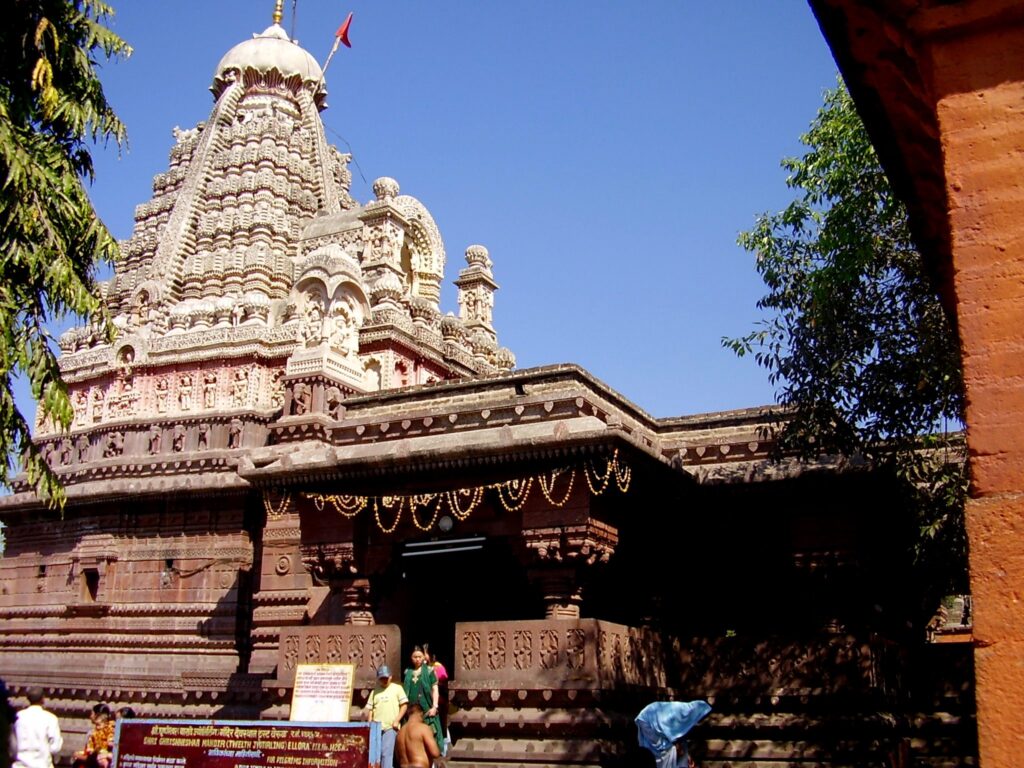
Grishneshwar Temple dedicated to Lord Shiva is one of the holiest Hindu pilgrimage sites in India. Located about 35 km away from the city of Aurangabad and about 2 km away from the UNESCO-listed Ellora Caves, it is home to the 12th and the last Jyotirlinga on earth.
History of Grishneshwar Jyotirlinga
This temple has been mentioned in the Shiva Purana and Padma Purana. The site was destroyed by the Delhi Sultanate in the 13th-14th century AD. The temple was reconstructed by Maratha ruler Shivaji’s grandfather, Maloju Bhisale of Verul, in the 16th century AD.
The current structure was built by Queen Ahilyabai Holkar of Indore in the 18th century AD after the fall of the Mughal Empire. The temple, built of red rocks, is composed of a five-tier spire or shikara. You can see the Dashavatars (ten avatars) of Lord Vishnu carved in red stone.
There is a court hall built on 24 pillars on which you will find carvings of various legends and mythologies of Lord Shiva. The sanctum houses the east-facing linga. You will also find a statue of Lord Shiva’s mount, Nandi, the bull in the court hall.
The story behind Grishneshwar Jyotirlinga
There are a couple of legends associated with this jyotirlinga. One legend says that there was once a woman named Kusuma, who would worship Lord Shiva every day, immersing the Shiva Linga in a tank along with her prayers. Her husband’s first wife was jealous of her devotion and murdered her son.
Although Kusuma was grief-stricken, she kept up her faith and her devotion to the Lord. It is said that Lord Shiva was so pleased with her devotion that he brought her son back to life. Kusuma requested the Lord to stay on, which is why Lord Shiva manifested himself as a jyotirlinga here.
Another legend has it that there was a Brahmin called Brahmavetta Sudharm, who lived with his wife Sudeha in the Devagiri mountains. The couple was childless, so Sudeha got her sister Ghushma married to her husband. On her sister’s advice, Ghushma would make lingas, worship them, and immerse them in the lake nearby. She was, finally, blessed with a baby boy. Over time, Sudeha became jealous of her sister and murdered her son and threw him into the very lake where her sister would immerse the lingas.
Though Ghushma’s daughter-in-law told her that Sudeha had a hand in the murder of her son, Ghushma continued her daily rituals believing totally in the Lord’s mercy. And true to her beliefs, as she went to immerse the linga, she saw her son walking towards her. Lord Shiva appeared before her and told her of her sister’s heinous deed.
Ghushma requested the Lord to forgive her sister. Pleased, the Lord granted her a boon. She asked him to stay on in that place, which is why he manifested himself as a jyotirlinga called Ghushmeshwar. The lake in which Ghushma immersed the lingas was called Shivalaya.
Interesting facts about Grishneshwar Jyotirlinga

- Grishneshwar is also called Ghushmeshwar and Kusumeshwar.
- Men are required to go bare-chested into the temple.
- This is the smallest jyotirlinga temple in India.
- The UNESCO World Heritage site, Ellora caves, is less than a kilometer away.
While you can visit this spiritual spot at any time in the year, it would be best to visit it during the winter months – between October and March. Visiting this ancient and divine destination during Mahashivratri would be the ultimate treat for any devotee!
Visit MakeMyTrip for bookings. Also, have a look at our various monthly issues.

Kedarnath Jyotirlinga : The highest among the 12 Jyotirlingas
August 15, 2022 in Pilgrimages, Uttarakhand
Situated at an altitude of over 3,500 m above sea level in Uttarakhand, Kedarnath Jyotirlinga Temple in Rudraprayag, Uttarakhand, this temple is the highest of the 12 jyotirlingas in India. It is located at the head of the Mandakini and mythical Saraswati River in the Garhwal Himalayas.
History of Kedarnath Jyotirlinga
One of the first references to Kedarnath is in the Skanda Purana which was written around the 7th and 8th centuries AD. The present structure is believed to have been constructed by Adi Shankaracharya about 1,200 years ago. It stands next to the site of a temple that is said to have been built by the Pandavas. It has been renovated many times over the centuries.
The temple is built with huge stone slabs over a rectangular platform. There are inscriptions in Pali on the steps. There are figures of various deities and scenes from Hindu mythology on the inner walls. A large statue of the Nandi Bull, Shiva’s mount, stands as a guard at the entrance.
The jyotirlinga is in the shape of a conical rock formation inside the temple – Lord Shiva in his Sadashiva form.
Kedarnath Jyotirlinga holds an intriguing story
The legend behind this famous place of worship is that after the Mahabharata war, the Pandavas performed penance to purge their sins – of killing their kin. To be able to do this, they were advised to seek Lord Shiva’s pardon. They searched high and low and finally, saw Lord Shiva at the spot where the jyotirlinga in Kedarnath is situated today.
It is said that Lord Shiva was not willing to forgive the Pandavas for their deceit and sins during the war and hence hid from them. He disguised himself as a bull and disappeared into the ground.
The second Pandava, Bhimasena, tried to pull him out of the ground by tugging at his tail and hind legs. However, Lord Shiva dug himself deeper and only reappeared in parts in different places – the hump in Kedarnath, the arms in Tunganath, the navel and stomach in Madhyamaheshwar, the face in Rudranath, and the hair and head in Kalpeshwar.
The Pandavas built temples at these five places – the Panch Kedars – for worshipping Shiva. This freed them from their sins.
Lord Shiva further promised to stay on in the sacred spot as a triangular jyotirlinga. This is why Kedarnath is so famous and revered by devotees.

Interesting facts about Kedarnath Jyotirlinga
- Since Kedarnath is located at such an altitude, winters are severe, making the temple inaccessible. So, it is open to the public only between April and November. It closes on the first day of Kartik (October-November) and opens in Vaisakh (April-May) every year. During the winters, the murtis (idols) from the Kedarnath temple are brought to Ukhimath and worshiped there for six months.
- In the 2013 floods, while adjacent areas were severely damaged, the Kedarnath temple itself was not affected.
- Kedarnath is the first of the Panch Kedars.
Considered one of the holiest temples for Lord Shiva, pilgrims devotedly visit this mountainous temple every year. While the main Kedarnath temple is normally closed during Mahashivratri celebrations, the Badri-Kedar festival is celebrated over a week in June every year.
Visit MakeMyTrip for bookings. Also, have a look at our various monthly issues.
