

Member Type Contributor


Gardens & Parks of Delhi
January 15, 2021 in City Guide, Delhi
Buddha Jayanti Park
Serenity is the hallmark of this beautiful wooded park, landscaped to commemorate the 2500th anniversary of Lord Buddha’s parinirvana. The park was originally conceived as a Japanese garden. It has a splendid statue of Lord Buddha and a flourishing Bodhi tree, which was a sapling of the original tree of enlightenment.
National Zoological Park
It is one of the largest zoos in Asia. The open enclosures provide a view of animals in natural surroundings. In autumn, migratory birds flock to the trees in this huge park, adding their number to the large bird count in the Zoo.
Raj Ghat
A simple square platform of black marble marks the site where Mahatma Gandhi, the Father of Nation was cremated. His last utterance ‘Hey Ram’ is inscribed at the base. Extensive lawns create a peaceful atmosphere.
Shanti Vana (the Forest of Peace)
It is the site where Jawaharlal Nehru, the first Prime Minister of India was cremated.
Vijay Ghat
Lal Bahadur Shastri, the second Prime Minister was cremated here.

Museums & Art Galleries of Delhi
January 15, 2021 in City Guide, Delhi
Crafts Museum, Thapar House
It showcases traditional and rural handicrafts.
Doll’s Museum
It is a part of the Children’s Book Trust and has an international collection of dolls that are dressed in their respective national costumes. The museum is located to the east of Bahadur Shah Zafar Marg.
National Gallery of Modern Art
The gallery has a fine collection of art from the 19th and 20th centuries. There are over 2,000 paintings, sculptures, and graphics.
National Museum
One of India’s most important museums exhibits artifacts from Prehistoric and Indus Valley Civilizations, sculptures from the Maurya, Gandhara, Gupta and other periods, bronzes, miniature paintings, copies of murals, Central Asian antiquities, textiles and decorative art, an anthropological section, and a handicrafts gallery. Nearby is the National Archives with a wealth of documents and records.
Nehru Memorial Museum (Teen Murti House)
It was the residence of Nehruji, the first Prime Minister of India and now houses a museum and research library dedicated to nim. A sound and light show-‘Tryst with Destiny’s held here every evening.

Sacred Sites Of Delhi
January 15, 2021 in City Guide, Delhi
Akshardham Temple
The massive temple complex of the Swaminarayan sect is set amidst 100 acres of well laid out lawns and lotus-shaped water bodies, on the banks of river Yamuna. It was inaugurated on November 7, 2005, by the President and Prime Minister of India and has become a must-visit site of Delhi. Akshardham is much more than a temple. The gigantic structure was ornately carved by over 11,000 craftsmen working diligently for over 300 million man-hours. The main temple is 141 ft. high, 316 ft. broad and 370 ft. long, and has 239 exquisitely carved pillars and nine domes. It enshrines an 11 ft. high gold-plated idol of Lord Swaminarayan. There are also idols of Lakshmi – Narayan, Shiva – Parvati, Radha Krishna, and Sita – Ram. Over 20,000 other idols of disciples are carved on the inside and outside walls. Finely carved floral motifs, 869 peacocks, and 149 full-sized elephants also grace the magnificent temple complex. About 2 kms. long parikramas have over 1,152 beautifully carved pillars.
 The exhibition halls studded with modern technologies like IMAX theatre, auto electromatic machines, and sound and light shows exhibit an amazing world of Indian culture and heritage. There is also a Disneyland kind of 12-minute boat ride that takes visitors through the vast magnitude of Indian culture. Models of Ajanta and Ellora caves and the thematic setting of our culture are brought to life through dummy depictions. The mammoth edifice resembles the Akshardham of Gandhinagar (Gujarat) and over 2 billion rupees are said to have been spent to create this wonderland.
Bahai’s House of Worship (Lotus Temple)
The lotus-shaped shrine of the Bahai sect invites followers of all faiths to meditate and pray in silence. The petals of the lotus are made of concrete clad with white marble which gives freshness and transparency to its surface. Around the blooming petals are nine pools of water, which light up in natural light. At dusk, the sight of the floodlit Lotus temple is simply spectacular.
Bangla Sahib Gurudwara
The sacred Sikh shrine at Baba Kharak Singh Marg commemorates the visit of Guru Harkrishan Sahibji.
Chhatarpur Temples
The massive structures built in white marble are just 4 kms. from Qutb Minar. worth a visit. The main shrine is dedicated to Goddess Durga.
Digambar Jain Mandir
This important Jain temple on the eastern end of Chandni Chowk is dedicated to Lord Adinath. It was built in 1656, as a part of the city of Shahjahanabad and also has a well-known bird hospital.
Hanuman Mandir
This small shrine near Connaught Place was built in 1724 by Maharaja Jai Singh of Jaipur. It is one of the important Hindu shrines of the city and very popular among the devotees of Lord Hanuman.
Hazrat Nizamuddin Aulia
The sacred Muslim pilgrim site is dedicated to Sheikh Nizamuddin Chisti, fourth in the line of Chisti saints. He was born in Budaun in Uttar Pradesh in 1236 and lived most of his life in Delhi. Among his illustrious disciples were the Sultans, Alauddin Khilji and Mohammed bin Tughlaq and the celebrated poet, Amir Khusro. Sheikh Nizamuddin died in 1325 and soon after his burial at this spot the adjacent area became the coveted cemetery of Muslim nobility. Every Thursday, after sunset qawwals, sing the melodious lyrics of Amir Khusro.
Fatehpuri Masjid
The mosque was built in 1650, by Fatehpuri Begum, one of the wives of emperor Shah Jahan. Located on the western end of Chandni Chowk, the mosque is surmounted by a single dome and flanked by minarets.
Jama Masjid
 The red sandstone mosque was built by Shah Jahan between 1644 and 1650. It is set on a high platform and can be reached by steps on the north, south, and east sides. The rectangular prayer hall has a magnificent facade of arches decorated with marble frames and inscribed panels. The towering minarets of the mosque dominate the Old Delhi skyline and afford a fine view of the city.
Lakshmi Narayan Temple (Birla Mandir)
The massive temple dedicated to Narayana (the Preserver) and Lakshmi (the goddess of wealth), is the most popular Hindu temple of the city. It was built in 1938, by an eminent industrialist Raja Baldev Birla and inaugurated by Gandhi Ji. The temple has a large number of idols representing various Hindu deities,
Sisganj Gurudwara
It lies at Chandni Chowk and is associated with Guru Teg Bahadur, who was beheaded here in 1675, on the orders of Emperor Aurangzeb.
St. James Church
It was built by James Skinner and consecrated in 1836 and is the oldest surviving church in Delhi. The church is of a western classical design with a Greek cross plan.
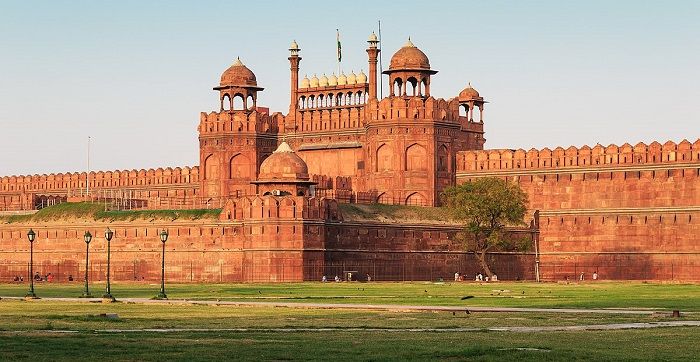
Red Fort (Lal Qila)
January 15, 2021 in City Guide, Delhi
It was built in the 17th century by Shah Jahan when the Mughal capital was shifted from Agra to Delhi. Shaped like an irregular octagon, the fort is about 2 kms. in circumference. The river Yamuna once flowed besides its battlements. Its handsome gates Lahore, of Delhi and Elephant, are masterpieces of builder’s art. Within the ramparts are splendid ornamented buildings, pavilions, gardens, tanks, the Moti Masjid a marvel in marble, and two museums, the Archaeological and War memorial. The buildings worth visiting are – Naubat Khana, Diwan-i-Am, Diwan-i-Khas, Rang Mahal and Khas Mahal. A Sound and Light show recreates the history of Delhi and this Fort. The Red Fort was the last fort of Delhi, it witnessed the glory and fall of Mughals, the British rule, and then the dawn of Indian independence.

Rashtrapati Bhavan
January 15, 2021 in City Guide, Delhi
The spectacular official residence of the President of India set on the eminence of the Raisina Hill, sprawls over an area of 330 acres. It was designed by Sir Edwin Lutyens and is one of the largest residential buildings in the world with 340 rooms, 37 salons, 74 lobbies, and loggias, one km. a long corridor, 18 staircases, and 37 fountains. In the front are a large court and Mughal-style gardens in the back, which are open for public viewing in February. The most magnificent room in the Rashtrapati Bhawan is the Durbar Hall, which lies directly under the main dome.
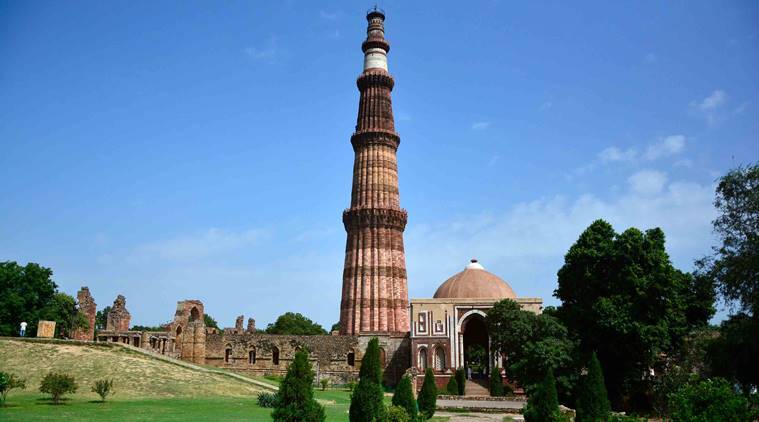
Qutub Minar
January 15, 2021 in City Guide, Delhi
This most famous landmark of Delhi towering above the Lal Kot monuments is one of the World Heritage Sites of UNESCO. It is 72.5 meters tall and tapers from a base diameter of 14.4 meters to a peak diameter of 24 meters. The five-storeyed minar has three stories built of red sandstone and two of marble and sandstone. Each story is clearly distinguished from the outside because of its projecting balconies. Its foundation was laid by Qutub- ud-din Aibak (1193) and was completed by his son-in-law and successor Shamsuddin Iltumish. The Devanagari inscriptions on the minar mention that it was damaged in 1326 and repaired by Muhammad-bin Tughlak and in 1368, Firoz Shah replaced the upper story and added two floors, making liberal use of marble stone.
A unique 7 meters high Iron Pillar in the courtyard of Quwwat-ul-Islam mosque was perhaps a flagpole of a 4th – 5th century Vishnu temple. It has remained completely rust ree for over 1500 years and is a tribute to ancient Indian metallurgy. Other attractions nearby are – the Tombs of the Sultans Iltumish (1235), Alauddin, Balban, and of Adham Khan, son of the emperor Akbar’s wet nurse.

Jantar Mantar
January 15, 2021 in City Guide, Delhi
This unique observatory was designed and built by Mirza Raja Jai Singh II of Jaipur in 1719. It is surrounded by stately palm trees and has a number of masonry instruments that were used to study the movement of constellations and stars in the sky. The Samrat Yantra, a huge sun-dial shaped like a right-angled triangle is the largest instrument here.

Purana Qila (Old Fort)
January 15, 2021 in City Guide, Delhi
The grand old fort, one of the most spectacular monuments in Delhi, is believed to have been built by the Afghan ruler Sher Shah Suri (1538 – 1545). As one enters from the Zoo side, one sees at the far end a small octagonal red sandstone tower, the Sher Manzil. A little ahead is the Qila-i-Kunha mosque. A Field Museum nearby exhibits artifacts discovered in the area.

India Gate
January 15, 2021 in City Guide, Delhi
India’s Arc d’ Triomphe’s’ stands majestically at the eastern end of Rajpath, the great avenue with wide lawns on either side of it, that leads to Rashtrapati Bhavan. Formerly known as the All India War Memorial, the 42-meter high arch was designed by Lutyens and built in 1931, in the memory of soldiers of the Indian Army who died in World War-I. Names of 13,516 soldiers are inscribed on its walls. In 1971, an eternal flame was lit here to honor the ‘Amar Jawan’, the immortal soldier. At night the view of floodlit India Gate is spectacular.

Humayun’s Tomb
January 15, 2021 in City Guide, Delhi
This World Heritage Monument built by Haji Begum, the widow of emperor Humayun and designed by Persian architect Mirak Mirza Ghiyas, served as a model for the world-renowned Taj Mahal. It was completed in 1565, eight years after the death of Humayun, and is the first great example of the Mughal tomb – in – garden complex. Several other members of the Mughal royal family lie buried here and many tombstones can be seen on the terrace.
