

Member Type Contributor


“Kinnaur” The Land Of God
June 2, 2020 in Himachal Pradesh
The secluded district of Kinnaur is studded with towering peaks, high altitude valleys, glaciers, and fast-flowing rivers. The breathtakingly beautiful1 district is sparsely populated with about 77 villages and no major urban center.
Kalpa
 This main town of Kinnaur district is set at a height of 2759 m. about 12 kms. from Recong Peo, surrounded by vineyards, apple Peo, orchards, chilgoza pines, cedar, and deodar forests. It affords a panoramic view of the majestic Kinner Kailash and came into prominence when Lord Dalhousie proposed the construction of Hindustan- Tibet Road in the 19th century. Places worth seeing are the Narayan – Nagini temple and Buddhist monasteries. The thickly wooded Lippa, located nearby on the banks of Taiti stream is known for its Buddhist monasteries.
Recong Peo
 Recong Peo, the headquarters of Kinnaur district is perched at an altitude of 2290 meters amidst scenic surroundings. There is an ancient gompa – Hu-Bu-Lan-Kar established by Rinchensang-po (950 1055) and a new gompa commemorating the venue of Kalachakra initiation conducted by Dalai Lama in 1992. The sight of Kinner Kailash from here is awesome.
 Sarahan
The beautiful gateway to Kinnaur lies 176 kms. from Shimla. It is known for majestic Bhimkali Temple, surrounded by snow-clad mountains. The sacred shrine is revered by the Hindus and Buddhists. A Pheasant Breading Centre and stadium are also worth seeing.

“Manali” India’s Adventure Playground
June 2, 2020 in Destinations, Himachal Pradesh
Magnificent Manali, one of the most popular hill resorts of the country is set picturesquely on the confluence of Manalsu and Beas rivers, surrounded by snow-clad peaks and thick forest and fruit-laden orchards. Mythological legends indicate that the name Manali is derived from Manu-Alaya’, the home of Manu, the great Hindu lawgiver and it was from here that the human race came into being after the great deluge.
 Hadimba Devi Temple: The pagoda style shrine surrounded by thick deodar trees is dedicated to goddess Hadimba or Hirma Devi. It was built in 1553, by Raja Bahadur Singh and is the main attraction of Manali.
Manu Temple (3 kms.): It is the only temple dedicated to the legendary sage.
Tibetan Monasteries: There are 3 monasteries, two of them are in the town and one at Aleo on the left bank of Beas river. Tibetan handicrafts and carpets can be purchased here.
Mountaineering Institute (3 kms.): It lies on the left bank of river Beas and imparts training courses in trekking, mountaineering, skiing, and water sports.
Vashista Hot Springs & Temple (3 kms): The village on the left bank of river Beas towards Rohtang pass is known for hot springs and temple of Vashist Muni.
Around Manali
Jagatsukh (6 kms.): It was once the capital of Kullu state and is known for the ancient temples of Lord Shiva and Sandhya Gayatri built in the Shikhara style.
Solang Valley (13 kms.): The valley extending from Solang village to Beas Kund is a veritable paradise for nature lovers. The breathtaking views of snow-clad peaks and glaciers make it one of the finest picnic spots in the Kullu valley. The winter skiing festival is organized in the valley.
 Rohtang Pass (51 kms.): The gorgeous gateway to Lahaul Spiti, Pangi, and Leh valley is set at an altitude of of3979 meters. The highway to Keylong/Leh passes over this pass of about 1 km. It opens for vehicular traffic from Jun. to Oct. The breathtaking beauty of the mountains flanking the pass, the glaciers and Chandra river flowing down the Lahaul valley leaves a lasting impression on the visitors.

Kullu, The Nature’s Heaven
June 2, 2020 in Destinations, Himachal Pradesh
 Kullu town is set on the banks of river Beas in the strikingly beautiful Kullu valley, also known as the ‘valley of gods’
Raghunathji Temple: This famous shrine was built in 1657 and dedicated to Lord Raghunathji, the principal deity of the valley. The idol of the presiding deity is said to be brought from Ayodhya, about 400 years ago.
Kullu Dussehra: The world-renowned annual Dussehra festival of Kulu is celebrated in September/ October. The festivities are organized at Dhalpur maidan, about 1 km.from Raghunathji Temple. During this time icons of all the deities of Kullu valley are brought here in colorful processions to attend the darbar of Lord Raghunathji.
Around Kullu:
Naggar (27 kms.)
The beautiful site on the banks of Beas was the capital of Kullu state for over 1400 years. It was founded by Visudh Pal and has a 16th-century castle, which has now been converted into a hotel. Naggar has three old shrines dedicated to Lord Vishnu, Tripura Sundari, and Krishna. It is also associated with Nicholas Roerich, an internationally renowned artist from Russia.
 Manikaran (45 kms.)
This pilgrim center of Hindus and Sikhs is famous for its hot sulfur springs. It has a Gurudwara and temples of Lord Ramchandra and Shiva.
Lahaul & Spiti
The Lahaul and Spiti district adjoining Ladakh is an entirely different world – snowbound and isolated from the outside world for over 9 months in a year. The inhospitable terrain full of glaciers and high altitude lakes is endowed with awe-inspiring beauty. Buddhism was introduced here in the 7th century and the people of the region have preserved their unique culture and heritage. The district is dotted with over 53 monasteries, which are not merely the seats of religion but the founts of power and repositories of art and religious manuscripts. The main towns of the district are Kyelang and Kaza.

Amarnath Yatra
May 25, 2020 in Jammu and Kashmir, Pilgrimages
Amarnath cave, the sacred abode of Lord Shiva is one of the most important Hindu pilgrim centers in the country. The holy cave perched at an altitude of 3962 meters is 2 feet long, 55 feet broad, and 50 feet deep. It enshrines a unique ice Shivalingam, which is created naturally by water dripping through the limestone roof of the cave. The cave shrine can be visited from the first week of July to mid-Sept.
 The State government makes elaborate arrangements for the pilgrims and is well supported by volunteers. Chhari Mubarak’, the symbolic emblem of Lord Shiva, is carried on foot by devotees from Srinagar to the Amarnath Cave in. various stages. The traditional route from Pahalgam to Amarnath via Chandanwari, Sheshnag and Panchtarni are endowed with breathtaking vistas. One can also visit Amarnath from the Sonamarg side. The trek to the sacred site is just 16 kms. starting from Baltal.

Vaishno Devi
May 25, 2020 in Jammu and Kashmir, Pilgrimages
The sacred abode of Goddess Vaishno Devi is perched at a height of 5,200 ft. on the holy Trikuta Hills. The cave shrine of Mata Vaishno Devi is regarded as one of the holiest Hindu temples of the country. Katra, 48 kms. from Jammu is the base camp for visiting the holy cave and is well connected by buses. From here one has to trek a distance of 13 kms. to reach the shrine. Obtain a yatra slip from the yatra registration counter at the Tourist Reception Centre at the Katra bus stand, before starting the journey.
The holy pilgrimage formally commences from Darshini Deori, at the northern end of the old Katra bazaar. The journey has to be undertaken by foot, ponies, or on palkis or dolis (palanquins). Mata Vaishno Devi Shrine Board manages the shrine and the yatra with great efficiency, making the pilgrimage an unforgettable experience. The entire route is paved, well lit, and kept clean. Public utilities, bathrooms, shelters, medical units, and shops are located at regular intervals. The holy cave enshrines three natural rock images (Indian) of the Goddess(Mata) in her three forms – Maha Saraswati, Maha Lakshmi and Maha Kali, which represents creative, preservative and destructive aspects of the divine energy.
According to legends, the darshan of Mata is rendered incomplete without VIsiting the Bhairon Temple, located 2.6 kms. from the main sanctum.

Leh (Ladakh)
May 25, 2020 in Jammu and Kashmir
Leh, the ancient capital of the Ladakh region is perched at an altitude of 3,350 meters amidst starkly beautiful mountains, which gently blend into an oasis of lush fields. The breathtakingly beautiful town is laden with palaces and monasteries. It was a flourishing caravan trade center between Punjab and Central Asia and between Kashmir and Tibet. Today, Leh has emerged as an important tourist destination providing an unusual holiday. It is an ideal base for trekking mountaineering, camping, and white water rafting. The region of upper Indus Valley around Leh is the cultural heartland of Ladakh and is studded with several Buddhist monasteries (gompas) and magnificent palaces.

Leh Palace: The nine-storeyed majestic palace was built by Sengge Namgyal, the ruler of Ladakh during the early 17th century. It is said to have served as the model for the famous Patola Palace in Lhasa (Tibet). Within the palace are old wall paintings depicting the life of Lord Buddha. The small corridors have over 100 years old tankas or painted scrolls, statues, and other armaments.
Leh Monastery: It is perched high above the valley-crags and dominates the palaçé and the town, symbolizing the supremacy of the Spiritual King. The monastery has a solid gold statue of Buddha, painted scrolls, ancient manuscripts, and wall paintings.
Namgyal Tsemo: Another hill rising above Leh town is occupied by a small fort and monastery complex of the Namgyal Tsemo peak. It was built in the 16th century by King Tashi Namgyal and is believed to be the earliest royal residence in Leh. Nearby is a Gonkhang, the shrine of the guardian deities, and a temple dedicated to Maitreya (the Future Buddha). Both the shrines house excellent murals.

Leh Mosque: The magnificent mosque is a fine example of Turko Iranian architecture.
Ladakh Ecological Centre: It lies on the western edge of the town and is engaged in the development of agriculture, solar energy, health, and environmental awareness in the region. There is also a small library and a shop selling local handicrafts.
Shanti Stupa: The splendid Shanti Stupa or the Peace Pagoda” atop a hill was built in 1980, with the help of Japanese Buddhists.
Changspa: This settlement on the outskirts of Leh is known for its exotic scenic beauty and colorful bazaar. The Moravian church lies on the way to Changspa.
Around Leh
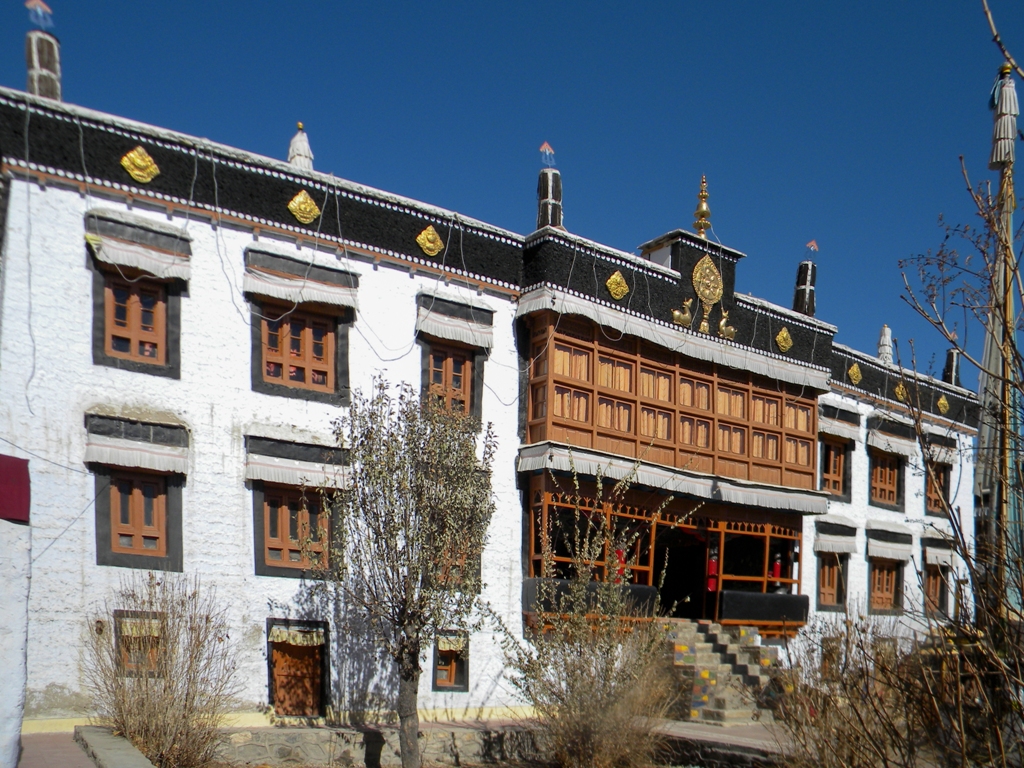 Sankar Gompa (3 kms.)
The 19th-century monastery is the only one built on valley level. It is the seat of the yellow sect of the Buddhists and has a rich collection of miniature statues of pure gold and several wall paintings.
Choglamsar (7 kms.)
It is the main Tibetan refugee settlement in Ladakh. Sporting activities like polo and golf can be enjoyed here.
Alchi Monastery (70 kms.)
The 12th-century gompa on the banks of Indus is one of the most beautiful gompas of Leh region. Alchi is famous for its exclusive wall paintings.
Hemis Monastery (43 kms.)
Hemis nestled atop a green hill is the biggest and wealthiest monastery of Ladakh. It was built in 1630, during the reign of Sengge Namgyal. The masked dance performance is worth seeing during the celebrations of the birth anniversary of Guru Padmasambhava in June. The monastery has gold statues and stupas adorned with precious stones. It has a rich collection of tankas, including the largest tanka in Ladakh which is unfolded only once every 12 years. (Last displayed in 2004)
Hemis High Altitude National Park (35 kms.)
This unique park covering an area of 600 sq. kms. is inhabited by some of the most exotic and endangered animal species like – shape, bharal, ibex, snow leopard, etc.
Phiyang (20 kms.)
It lies on the Leh-Kargil road and was built by Tashi Namgyal in the latter half of the 16th century. The palace-like gompa belongs to the Red Cap sect of the Buddhists.
Shey (15 kms.)
The ancient capital of Ladakh is believed to have been the seat of power of the pre- Tibetan kings. Its abandoned palace has a temple enshrining a 7.5-meter high copper statue of Buddha, plated with gold. The statue dates back to the 17th century and is perhaps the largest of its kind.
Spituk Monastery (8 kms.)
The 15th-century monastery atop a hill is said to be the oldest establishment of the Gelugpa sect in Ladakh. It is built in Tibetan style and houses a library of Tsongkapa, the sect’s founder.
Thikse Monastery (20 kms.)
It is one of the largest and architecturally most impressive gompas in Ladakh. The monastery is mainly known for its exotic murals and wall paintings.

Jammu, The Winter Capital
May 24, 2020 in Jammu and Kashmir
Jammu, the winter capital of the State sprawls on the banks of river Tawi with Trikuta mountain range in the backdrop. The antiquity of this city of ancient temples and the magnificent palace is shrouded in myths and legends. It is said that Raja Jambu Lochan, a Rajput king of later Vedic period founded his capital here and named it Jambupura.

Raghunath Temple: The magnificent temple complex set in the heart of the city is one of the most important and the largest shrines of northern India. Its construction was started in 1835, by Maharaja Gulab Singh, the founder of Jammu and Kashmir kingdom and was completed by his son Maharaja Ranbir Singh in 1860. The complex consists of 17 temples and the main shrine are dedicated to Lord Raghunath (Rama).
Ranbireshwar Temple: This biggest Shiva temple in North India was built by Maharaja Ranbir Singh in 1883. It enshrines a large number of Shiva lingams. The central lingam in black stone is seven and a half feet high and the twelve crystal lingams measure from 15 cms. to 38 cms.
Peer Khoh: The ancient cave temple on the circular road has a naturally formed Shivalingam, which is highly revered by the devotees.

Bahu Fort: The ancient fort set majestically on a rock face, overlooks the gently flowing Tawi river. It is well known for the temple of Goddess Maha Kali, which is considered next only to the famous Mata Vaishno Devi Temple. The beautiful Baghi bahu garden is located at the base of the fort.
Amar Mahal Museum & Library: The magnificent red-brick palace is perched elegantly on a hill overlooking the Tawi river. It was built by Raja Amar Singh and now houses a museum exhibiting excellent miniature paintings from Kangra School, paintings of contemporary Indian artists and portraits, etc. But, the highlight of the museum is 120 kg. solid gold Dogra throne, which was used by the erstwhile Maharajas. The library at the palace has a collection of over 25000 books.
Mubarak Mandi Palace Complex: The palace complex is a blend of Rajasthani and Mughal styles of architecture with influences of even Baroque European style. It affords a fine view of the Tawi river on one side and the city on others and had served as the residence of the erstwhile Dogra rulers. The Pink Hall now houses the famous Dogra Art Museum with a rich collection of rare paintings.

Around Jammu
Patnitop (112 kms.)
Panoramic Patnitop sprawls on the lush plateau, at an altitude of 2024 meters on the Jammu-Srinagar highway. The charming resort amidst thickly wooded forests is probably the best-developed tourist center of Jammu. It commands awe-inspiring views of the scenic surroundings and is dotted with several beautiful picnic sites. During winters Patnitop receives good snowfall and provides opportunities for various snow games like skiing. The 600-year-old temple of Naga (cobra) at Ishadhari is highly revered by the devotees: The three must-visit sites on the outskirts of Patnitop are – Chinar Garden, Picnic Spot, and Skating Garden.
Mansar Lake (60 kms.)
This lovely lake amidst thickly wooded forest is a popular excursion point. Boating facilities are available here. A food and crafts festival is also organized here by J&K| Tourism around the festival of Baisakhi.

Srinagar, The Summer Capital Of Jammu And Kashmir
May 24, 2020 in Destinations, Jammu and Kashmir
Scenic Srinagar, the summer capital of Jammu & Kashmir state sprawls elegantly on both sides of the river Jhelum. According to Kalahana, the author of Rajatarangini’, this city of lakes and gardens was originally named is Srinagari and was founded by emperor Ashoka (3rd century B.C.). The present town was established by Pravarasena II and finds mention in the travelogues of Hiuen Tsang. Persian influence over the city’s art and culture were introduced by the Afghan Badshah, Zain-ul-Abidin (1420-70). But, most of the city’s formal beauty and its fine mosques are a result of the patronage provided by the Mughal rulers. Srinagar was the summer resort of the Mughals, who built gorgeous gardens with fountains, waterways, pavilions, and terraces placed between groves of chinar and willow.

Dal Lake: Delightful Dal, the largest lake of the city is indeed the icon and focal point of Srinagar. The lovely lake is divided by causeways into four parts Gagribal, Lokutdal, Boddal, and Nagin. Both Lokutdal and Boddal have an island in the center – called Rup Lank or Char Chinari and Sona Lank respectively. Nagin Lake at the foot of Shridhara (Zabarwan) mountain is the smallest and the most beautiful part of the Dal. One can also enjoy shikhara rides, staying at houseboats, swimming, and water skiing, etc. at the Dal.
Hazratbal Mosque: The white marble mosque on the north-west shore of the Dal Lake, enshrines a holy hair (bal) of Prophet Mohammed and is regarded as one of the holiest mosques of Kashmir.
Shalimar Bagh: The beautiful terraced garden was laid by emperor Jehangir for his beloved wife Nur Jahan. It has fine fountains in between and a canal runs through the middle of the garden which is supplied with water from Harwan. The fourth terrace of the garden is by far the best and was once reserved for the royal ladies. The panoramic view of the garden and lake can be enjoyed from here.
Nishat Bagh or the ‘garden of bliss The beautiful garden with several terraces and a central watercourse was built in 1633, by Asaf Khan, the brother of empress Nur Jahan on the banks of the Dal.
Pari Mahal: The grand palace perched atop a hill near the Cheshma Shahi garden was originally a Buddhist monastery and was later converted to a palace by Dara Shikoh, the eldest son of emperor Shah Jahan. It became a royal observatory and a school of astrology was established here by Dara Shikoh.

Jami Masjid: This important mosque of Srinagar was first built by Sikandar- Butshikan in 1402 and further additions to the structure were made by his son Zain-ul-Abidin. The present structure was built by Aurangzeb and is noted for its 300-plus wooden pillar.
Cheshma Shahi: The magnificent garden overlooking the city and the lovely lake was built by Shah Jahan in 1632. It is the smallest of Srinagar’s Mughal gardens with three artistically designed terraces and a natural spring of water enclosed in a stone pavilion. The water of the spring is said to possess some curative properties.
Shah Hamadan Mosque: It is located on the banks of river Jhelum and is one of the most beautiful and oldest mosques of Srinagar. The mosque with pagoda-like spire commemorates Mir Sayyad Ali Hamdani, a holy sage from Iran.
Sri Pratap Singh Museum: It is housed in a beautiful palace and exhibits archaeological artifacts, mammoth remains, paintings, old coins, and notes, etc.

Hari Parbat Fort: It has a shrine of goddess Sharika, (Durga). The hill was first fortified by emperor Akbar in 1592-98 and was further developed in the 18th century by an Afghan governor Atta Mohammed Khan. Presently the fort is in the state of ruins and the historic shrine of Shah Makhdum Sahib on the slopes of Hari Parbat hill is visited by people of all faiths.
Chatti Padshahi Gurudwara: The sacred Sikh shrine near Kathi Darwaza, in Rainawari, commemorates the visit of sixth Sikh Guru Hargobind.
Shankaracharya Temple: This ancient temple on the Takht-i Sulaiman hill is dedicated to Lord Shiva and is said to be built on the site where the Advaita philosopher saint, Adi Shankracharya stayed during his visit to Kashmir. Historians believe that the first edifice on this site was built by emperor Ashoka’s son Jaluka around 200 B.C. and was later rebuilt in the 6th century by king Gopaditya. The temple affords an awe Inspiring view of the Dal Lake and the snowy peaks of the Pir Panjal range.
Around Srinagar
Achabal (58 km.)
Alluring Achabal near Anantnag was the pleasure retreat of Nur Jehan. Jehangir laid out a fine Mughal style garden over here for his beloved wife.
Aharbal (51 kms.)
The spectacular waterfall is formed by river Veshav, which plunges from a height of 24.4 meters into a narrow gorge.
Charar-i-Sharif (30 kms.)
It lies on the road to Yusmarg and is famous for the ziarat’ or shrine of Sheikh Noor-ud-Din, the patron saint of Kashmir. The architecture of the shrine is noteworthy.

Dachigam National Park (21 kms.)
It covers an area of 141 sq. kms. with altitudes varying between 1700 and 4300 meters. The most famous inhabitants of the park are hangul or the Kashmir stag, musk deer, Himalayan black bear, Himalayan marmot, leopard, species of wild goats, etc. Exotic birds like crimson tragopan, the iridescent monal pheasant, etc. can also be seen here.
Sonamarg (84 kms.)
Sonamarg, the ‘Meadow of Gold’ nestles at an altitude of 2730 meters in the valley carved out by the waters of the mighty Indus river. The beauty of the blooming valley full of alpine flowers and towering conifers with incredible Indus meandering through it and snow-clad peaks in the backdrop leaves a lasting impression on the minds of the visitors.
Kheer Bhawani Temple (27 kms.)
It is dedicated to goddess Raginia Devi (Durga) at Tula Mula village and is considered to be the most important Hindu pilgrim center in Kashmir, after Amarnath cave. A marble temple with a golden dome stands in the middle of the pool created by the spring water.
Pahalgam (96 kms.)
Picturesque Pahalgam, an idyllic resort set on the confluence of Lidder and Shesnag streams is endowed with enormous natural beauty and scenic vistas. It is a perfect place for leisure, pleasure, and relaxation and is also an important trekking base, the most famous being the holy pilgrimage to the sacred Amarnath cave.
 Gulmarg (57 kms.)
Gorgeous Gulmarg, literally the Meadow of Flowers’ is one of the most unique hill resorts of the world. This huge grassy, cup-shaped meadow at an altitude of 2653 meters is surrounded by fir trees and majestic snow-clad peaks. The region of Gulmarg becomes all the more beautiful as one season changes into another. Gulmarg is also famous for various outdoor sports activities like golf, horse riding, skiing, trekking, etc. Golfing at Gulmarg’s 18- hole course is a unique experience. It is also the premier skiing resort during the winter. There is a facility of Gondola Cable Car at Kongdor, which carries you to the top of a ski run.

Visit Sambalpur!
April 22, 2020 in Odisha
Sambalpur is the Western Odisha region’s administrative, commercial and educational hub. The city contains many famous temples, historic buildings, and parks. Sambalpur is famous for premier educational institutes like Sambalpur University, Veer Surendra Sai Institute of Medical Sciences and Research (VIMSAR), Veer Surendra Sai University of Technology (VSSUT), Gangadhar Meher University, Indian Institute of Management Sambalpur and Odisha State Open University (OSOU). Hirakud Dam, the longest earthen dam in the world and the largest artificial lake of Asia, is at Hirakud.
After the independence of India, many commercial and government establishments sprung up in and around Sambalpur. Sambalpur is one of the major railway junctions in Odisha with the headquarters of the Sambalpur Railway Division under the East Coast Railway Zone of Indian Railways. National Highway 53, National Highway 55 pass through the City, and State Highway 10 & 15 originate from the city.
 Sambalpur is also the headquarter of Mahanadi Coalfields Limited since 1992, a subsidiary of Coal India Limited.
The world-famous Hirakud Dam, built-in 1956 across the Mahanadi River, about 15 km (9.3 mi) from Sambalpur, is a major tourist attraction. It is one of the longest dams in the world, about 26 km (16 mi) in length. It also forms the biggest artificial lake in Asia, with a reservoir covering 743 km2 (287 sq mi) at full capacity with a shoreline of over 640 km (400 mi). It also attracts a large number of migratory birds in winter.
The Leaning Temple of Huma, located about 25 km (16 mi) from Sambalpur, built in the 17th century, leans at an angle of approximately 47 degrees to the west. (Pasayat, 1998, 2003, 2004, 2007, 2008). It is one of a kind in India.
Samaleswari Temple is the main temple of the goddess Samaleswari, located on the banks of the river the Mahanadi. Sambalpur owes its name to her.
Chiplima (Chipilima Hydro Electric Project (CHEP)) located about 37 km (23 mi) from Sambalpur, is known for a natural fall (24.38 m (80.0 ft) in height) harnessed for generating electricity. It is an ideal picnic spot and famous for Ghanteswari Temple, the presiding deity of the place. This temple played an important role in river navigation in the past.
 Lost Temples of Hirakud Dam
These are remnants of temples submerged after the dam was completed in 1957. In summer, due to the receding water of the dam, the structures become visible. These hidden treasures have finally caught the attention of historians and steps are being taken to understand the historical significance of these temples which periodically go underwater, only to resurface again. Many temples have been destroyed after 58 years of underwater existence. However, some remain intact.
Interest in these lost temples has been rekindled after two stones, etched with writing (‘Shila Lekha’), was recovered from what is believed to be the Padmaseni temple of the submerged Padmapur village. The temples located inside the reservoir area were part of the then Padmapur, one of the oldest and most populous villages in the region before the dam construction. More than 200 temples were submerged by the dam; nearly 150 temples have either perished or are underwater and about 50 are visible during summer. These lost temples present excellent opportunities for scuba diving enthusiasts to explore under the Hirakud Dam. These temples are visible to visitors on boats only during the summer months of May and June.

Konark, The City Of Sun Temple!
April 22, 2020 in Odisha
 This small sea-side town was an important ancient port and is now world-renowned for the majestic Sun Temple – a World Heritage Site of UNESCO and a charming beach. Sun Temple: The magnificent shrine built by Ganga king Narasimha Deva – I in 1278, is the crowning glory of Orissan temple architecture. According to Rabindranath Tagore – ‘here the language of stone surpasses the language of man’. The massive structure was designed as a celestial chariot of the Sun-god, with twelve pairs of exquisitely carved wheels, drawn by seven horses. The 24 wheels are said to represent the fortnights of the year; the eight spokes in each wheel, the ancient division of the day and night into eight equal parts and the seven horses, are the seven days of the week. The temple was originally set on the beach and the sea waves almost touched its base, but now the elegant ruins of the temple are located amidst drifting sand, about 2 kms. from the sea. It is said that 1200 architects toiled for 12 years to create this magnificent structure. The 227 feet high main shikhara (tower) which is now collapsed, was visible from far out at sea and the shrine was known as the ‘Black Pagoda’ by sailors, in contrast to the whitewashed Jagannath temple at Puri. At the base of the collapsed tower were three subsidiary shrines, which had steps leading to the Surya images. The main sanctum is in ruins but the Nata Mandira (hall of dance), which remains in front of the temple and Audience Hall is intact. Of the 22 subsidiary temples which once stood within the enclosure, only two have survived – the Vaishnava and the Mayadevi Temple. On either side of the main temple are colossal figures of royal elephants and horses. The ornately carved temple also depicts aspects of life during the 13th century and is famous for erotic art.
Museum: This museum of Archaeological Survey of India lies just outside the temple enclosure. It exhibits sculptures and carvings recovered from the Sun temple.
Konark Beach: It is one of the most attractive beaches in the country. Konark Dance Festival: This famous festival is held in early December and attracts eminent dancers from all over the country.
 AROUND KONARK
Chaurasi (30 kms.) It is well known for the shrines ofAmareswar, Laxminarayan, and Barahi. Pipli(23 kms.) It is famous for handicrafts known as “Appliquework”. Beautiful bedspreads, cushion covers, bags, wall hangings, umbrellas, etc. are prepared using this artwork.
