
How long should you spend in Varanasi for Dev Deepawali? Some visitors try to do it in a single night, flying in for the evening and leaving the next morning. Others plan a week. Our answer, for most people, is three nights. Three nights gives you the eve of the festival, the festival itself and the morning after, with enough time in between to see the old city, rest, and take in a little beyond the ghats. Any shorter and you are only seeing the crowd; much longer and, unless you have a particular purpose, the city’s intensity can wear you down during its busiest week.
Here is how we would shape those three nights around Dev Deepawali, which in 2025 falls on Wednesday 5 November. Adjust the days if the date in your calendar differs.
Before you go
Book your accommodation early. Rooms near the ghats fill months in advance for Dev Deepawali, and rates are higher than usual. Staying within walking distance of the river matters, because traffic restrictions in the old city around the festival can make vehicle access difficult. Confirm with your host how to reach the property on the festival day, and whether you will need to walk the last stretch with your luggage.
Varanasi is served by Lal Bahadur Shastri International Airport at Babatpur, some distance north-west of the city, and by several railway stations, of which Varanasi Junction (also called Varanasi Cantt) and Banaras station are the main ones. Allow plenty of time for the drive from the airport to the old city, especially in the evening.
Night one: the eve
Arrive by early afternoon on the day before the full moon. Check in, drop your bags, and go straight to the river. Walk the ghats from Assi northwards in the late afternoon, watching preparations for the festival: steps being swept, lamps laid out, rangoli designs taking shape. Stay for the evening Ganga aarti at Dashashwamedh or Assi; on the eve it is held as usual and is more comfortable than on the festival night.
For dinner, eat somewhere near your guesthouse. Go to bed early; tomorrow is long.
Day two: the festival day
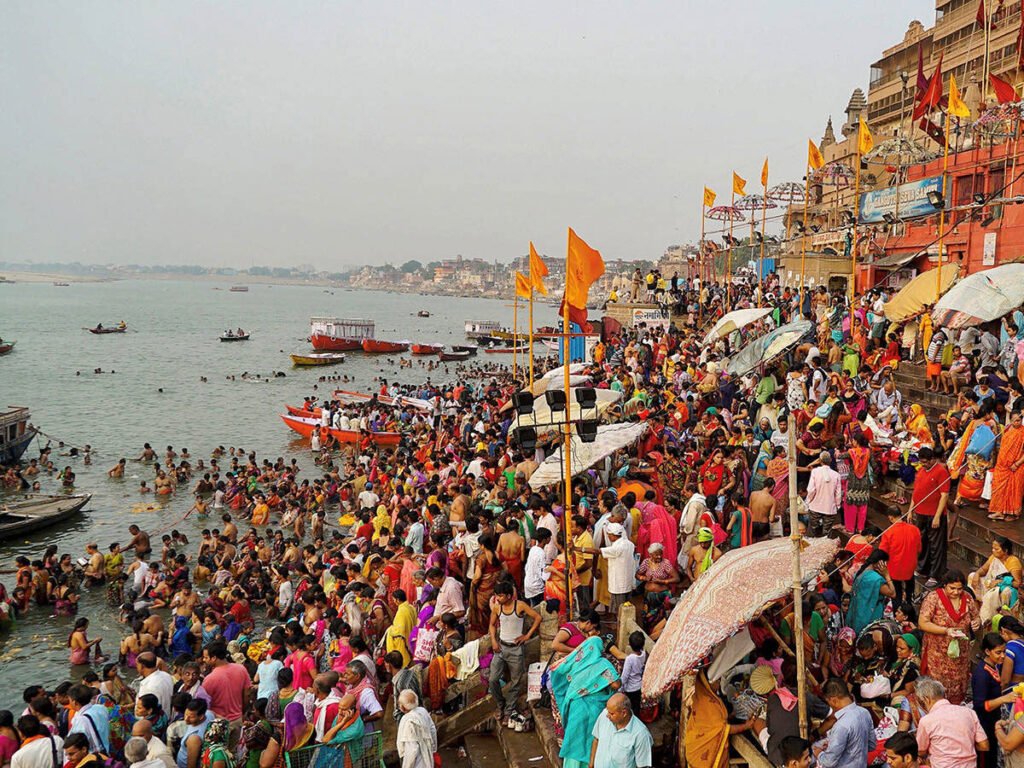
Wake before dawn and go down to the river. On Kartik Purnima, many pilgrims bathe in the Ganga at sunrise, and the ghats are full of quiet devotion. If you want a boat ride, the early morning is a good time; agree the route, duration and price before boarding.
After breakfast, rest. The middle of the day is the time to sleep, read or sit on a rooftop. In the afternoon, walk the old city lanes, where festival preparations are visible at street level, and try some of the local snacks.
By late afternoon, decide where you will spend the evening, and get there early. The main options are a spot on the ghats, a rooftop or terrace overlooking the river, or a boat. Each has its trade-offs, which we discuss elsewhere in this issue. Once in place, expect to stay put. The lighting of the lamps usually begins around dusk, followed by the aarti on the major ghats and, in some years, fireworks or light shows. The evening can stretch late.
Walking home afterwards will be slow. Follow the crowd’s direction rather than fighting it, and keep your group together.
Night two: the festival night
Sleep. You will need it.
Day three: the morning after
Go down to the river at sunrise again. The steps will be lined with burnt-out lamps, and the mood will be calm and reflective. Pilgrims may still be bathing, as the full moon period can extend across days depending on the lunar calendar. This is one of the best mornings for a boat ride, with the river quieter than on any day of the festival.
Spend the rest of the day on something beyond the ghats. Options include Sarnath, about 10 kilometres from the city, where the Buddha is believed to have given his first sermon after enlightenment, with its stupa, ruins and museum. Check museum opening days and times before you go. Alternatively, visit weavers’ neighbourhoods to learn about Banarasi silk, or Ramnagar Fort on the opposite bank of the river, the historical seat of the Maharaja of Benares.
In the evening, return to the ghats for the aarti, which continues every night. Without the festival crowds, you can finally sit and watch it properly.
Night three: the quiet night
Have a slow dinner. Walk the ghats at night, when lamps may still be flickering on some steps. This is the evening when Varanasi feels most like itself again.
Day four: departure
Leave in the morning. If you have an afternoon flight or train, you can fit in one more early walk along the river before you go.
Can you do it in two nights?
Yes, if you arrive on the eve and leave the morning after the festival. You will miss the quieter third night and the day beyond the ghats, but you will see the festival properly. One night is possible, but you will be fighting the crowds both coming and going, and you will see mainly the inside of a taxi and a crush of people.
Should you stay longer?
If you have time, Varanasi rewards longer stays, but after the festival. The week after Dev Deepawali can be pleasant, with cool mornings and fewer crowds. You could combine Varanasi with Sarnath, a day trip to Chunar Fort upriver, or a longer journey to Prayagraj, Bodh Gaya or beyond.
What three nights gives you
Three nights let you see the festival from three angles: being prepared, at its height, and in its aftermath. They give you two dawns on the river, a walk through the old city, a day beyond the ghats, and at least one evening when you can sit and watch without being pushed. That is not everything Varanasi has to offer, but it is the whole of Dev Deepawali, and it is enough to understand why people return year after year.
Packing for the three nights
Pack light, because you may carry your own bag through the lanes. Bring a warm layer for dawn on the river, which can be cool in November, comfortable shoes that slip off easily for temples, a small torch, a refillable water bottle and a scarf or shawl that doubles as a head cover. Leave valuable jewellery at home.
More from Issue 79
- Dev Deepawali index
- Editor’s letter: Varanasi & Dev Deepawali
- The ghats the night before, not only the night of
- A boat you should not book
- The old city in the afternoon
- What the lamps do to the lanes
- Three nights is the whole trip
- A priest’s morning, told by a guest
- Silk, not a shopping list
- Dates and the crowd calendar
- One village ghat upriver
- The photograph from the steps
Rameshwaram – Where Divinity Meets the Ocean’s Embrace
Ganga Dussehra
The Town You Sleep In
Why the base town shapes a monsoon waterfall trip more than any single fall, what to look for, and towns in Karnataka, Kerala and Goa worth considering.
One village ghat upriver
Train versus road that week
Markets before the 20th, not on it
Journeys Worth Discovering
Explore inspiring destinations, memorable journeys and travel stories from across India and beyond.
Explore destinations




